
The Basics
Music by Richard Wagner
Words by Richard Wagner
Based loosely on Gottfried von Strassburg‘s poem Tristan and other medieval sources
Language: German
Premiere date: June 10, 1865
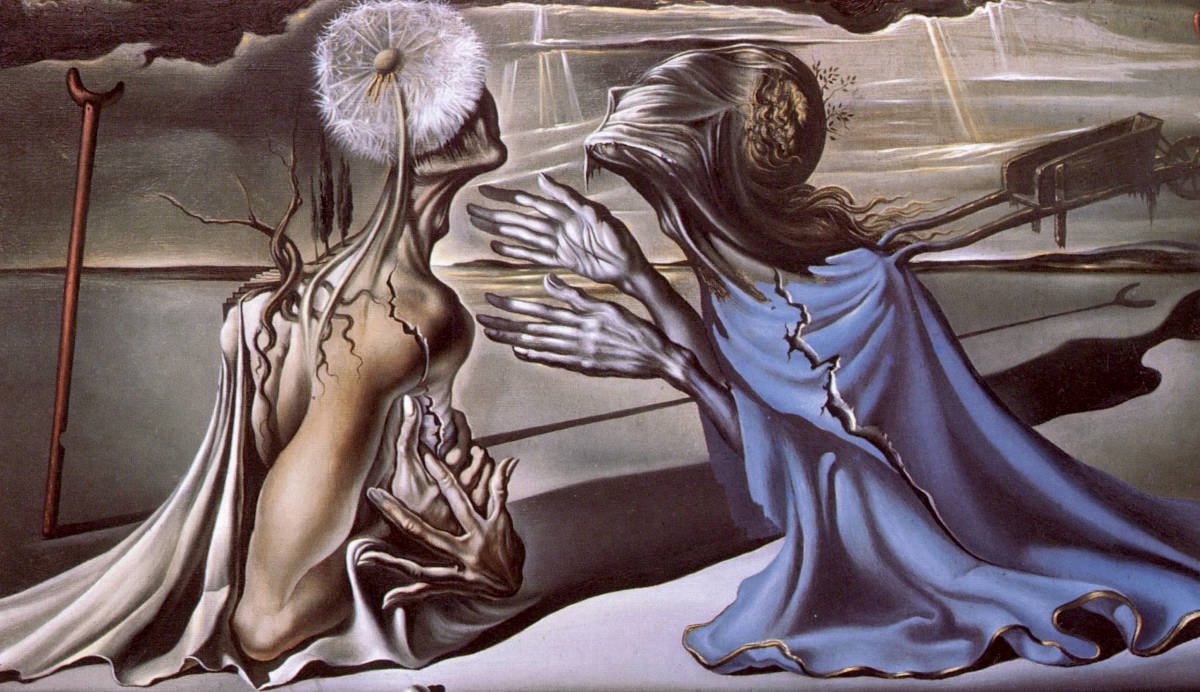
[Image: Salvador Dali’s “Tristan and Isolde,” a painted backdrop for Leonide Massine’s ballet “Tristan Fou,” staged at New York’s International Theatre in 1944.]
One-liner
The ultimate slow-moving car crash. This 4-hour tale of love potions, unfaithful knights, and the power of the Unconscious begins with a revolutionary chord that ultimately resolves in a transcendent death-orgasm that changed the course of music.

Themes

- Yearning
- Honestly that’s most of it! Yearning for love, yearning for sex, yearning for death
- The (exquisite) agony of self-denial
- The (exquisite) agony of being individual people rather than merged into total union
- The (seductive) appeal of oblivion
- The thin line between love and hate (or, if you will, “enemies to lovers”)
- Light vs. dark, day vs. night, conscious vs. unconscious, rational vs. irrational, visible vs. invisible
- Some of the classic Romantic opera tropes about individual passion vs. duty to country, adultery, love triangles, etc
- Chivalry in the very classic and literal sense — particularly the German term Minne, defined as “courtly love; a kind of chivalrous, serving love by a knight for a noblewoman, generally secret and sometimes adulterous”
- A common joke about Tristan is that “nothing happens, and then keeps happening for 4 hours.” While opera is often less interested in Events than in Emotional Consequences, here that idea is taken to extremes. Albert Lavignac says: “the situations are simple and the episodes not numerous. The whole interest of the drama lies in the various emotions of the hero and heroine.”
- Some audiences find this a very queer opera — not only do Tristan & Isolde yearn to consummate their forbidden love (hmm) and fuse into the same person (double hmm), but all the other characters seem intensely focused on the member of the lead couple matching their own gender.
- Scholars also love to discuss the religious/philosophical influences from Buddhism and Arthur Schopenhauer on this story of limitlessness and self-obliteration.
- Tristan is often nearly impossible to talk about without resorting to the language of sex: pursuit, arousal, plateau, interruption, denial, orgasm, resolution, ego death, etc. Opera had certainly been horny before Wagner (for two centuries!), but typically in small doses, or with plausible deniability, or contained in a larger context. Only one man was
bravehorny enough to write the first opera that actually is orgasmic.
Composer

Writer/composer Richard Wagner was one of the most confounding people who ever lived. An immensely complex, arrogant, brilliant, nasty, sensitive, and contradictory artist, Wagner was one of the most influential Europeans of the 1800s whose influence is still felt today in a huge variety of fields. I don’t have room here to even begin explaining his whole deal — great minds have spent their entire careers trying — but here are some relevant bits to start with.
He was almost unique in the history of opera by writing all of his own texts (libretti, or as he called them “poems”) as well as composing the music — these are almost always two separate jobs, but Wagner believed that a “music-drama” (his preferred term) could be the product of a single creative mind.
In his book A Night at the Opera, Denis Forman writes: “Wagner was his own librettist, his own manager, his own editor and his own hero. He thought he was pretty good in all of these capacities… it was a bit of a disaster that Richard had no one to work with but Wagner, for he was not only self-indulgent but also a megalomaniac.” But a sensible collaborator might have talked him down from some of his most ambitious ideas, “and where would we be then?”
And Tristan und Isolde is one of his most important achievements.
Creation
By the time Wagner started planning Tristan und Isolde (about 1854), he was 40 years old and had already lived enough to fill many biographies. After some early struggles across Europe, he’d composed some successful operas and spent several years as the music director of the Dresden Royal Theatre, then turned his life upside down by getting swept up in the Revolutions of 1848, getting exiled from the country, slowly destroying his marriage, and writing thousands of pages of essays about issues of music, drama, aesthetics, philosophy, nationality, antisemitism (his worst trait), and more. He and his wife Minna fled to Zurich, Switzerland, where they lived off the generosity of friends and admirers, particularly married women… until Wagner began to hook up with one of them, causing a quiet scandal that cut off some of the money.
In 1853, Wagner found a new married couple to rely on: the silk merchant Otto Wesendonck and his wife Mathilde, who were both huge fans. Their support allowed him to focus on his enormously ambitious plan for a cycle of mythic operas that would fulfill all his ideals for the future of musical drama, called The Ring of the Nibelung. In 1857, the Wagners moved into a cottage on the Wesendoncks’ property. Richard had grown emotionally distant from his wife Minna (it was mutual) and increasingly infatuated with Mathilde Wesendonck, who was much more closely aligned with his artistic ideas (including the idea that he was a genius). Mathilde was a talented poet, and he set five of her poems to music. But he also found himself stuck in the middle of the huge Ring project and distracted by his obsession with Mathilde.


After he became familiar with the medieval legend of Tristan and Iseult (two lovers who dare not break the laws of marriage by getting together, but who cannot bear to be apart) and discovered the philosophy of Arthur Schopenhauer (in which people are urged on by a restless Will, and the visible/intelligible world is merely a mask for the invisible underlying reality we cannot understand), he decided to take a break from the Ring. He channeled his barely-restrained erotic yearning for Mathilde into the poetry and music of a new opera about being so horny that you blow up your whole life and everyone around you.
And at two key moments of the opera, he incorporated music from his settings of Mathilde’s poems.
In the end, Minna caught one of her husband’s love-notes to Mathilde and the whole situation imploded, leading Wagner to leave Zurich, divorce Minna, break up with Mathilde, and find a new, even more subservient married woman to seduce. But that’s another story.
Likewise the story of how Tristan und Isolde finally reached the stage, thanks to the miraculous intervention of a gay teenager (and obsessive Wagner fan) who became king of Bavaria just when he was needed most, and the story of how this opera may have killed the first two tenors who tried to sing it (see Further Reading at bottom).
Musical style
An unsigned 2017 program note for the Utah Symphony offers a great analysis of the show’s importance:
Wagner had already challenged the music world with great operas such as Die Meisersinger and Tannhäuser as he honed his concept of all-encompassing music-drama: the Gesamtkunstwerk that unites design, music and stagecraft into a totally immersive artistic experience. But in Tristan he combined these ideas with harmonies that proceed without traditional resolution – ambiguous and layered, like thought itself. They hang in the air expressing emotion rather than melody, as if the orchestra were within us and artistic boundaries were brushed away. If a composer could write music like this, anything was possible. Why, for instance, should a painting be a picture of something?
Wagner’s building blocks are motivic phrases that are never classed as melodies, no matter how melodic they might sound, because they never seek to end in a musical resolution; instead, like our deepest feelings, they seem to have no particular beginning or end. Endless scholarship has been devoted to the meaning and interplay of Wagner’s motifs (Leitmotiven), but he did not expect us to track them as we listen. We sense their meaning and feel their impact more deeply through rapt listening than we could through conscious analysis.
Personally, the biggest mental adjustment I had to make when listening to Wagner was to give up on the expectation of “singers accompanied by an orchestra.” That may be appropriate for many, many opera composers, but in this case it’s the opposite: a story told by an orchestra, with the singers being more like dolls that the orchestra can use to act out its story, or prisms through which the energy coming out of the orchestra is channeled and directed to us. That being said, it’s still some of the most difficult singing you’ll ever encounter in your life! Wagner doesn’t ask for much, only heaven and earth.
Setting


We’re in the world of Celtic legends, the semi-fictional time of King Arthur. So these characters are only vaguely related to the historical record, but they may be linked to a sixth-century king of Cornwall named Marc or Conomor. For Wagner’s purposes, the important thing is that Ireland and Cornwall have been in conflict, and Brittany is on the Cornish side. Act I begins in the aftermath of a peace deal, as a Briton ship sails across the Celtic Sea from Ireland to Cornwall carrying the Irish princess, who will marry the Cornish king and reestablish good relations. Act II takes place after they land in Cornwall. Act III brings us to Brittany. So the action essentially moves in a straight line southeast, from Ireland to Britain to continental Europe.
Characters

- Tristan, a knight from Brittany, nephew and champion of King Marke (tenor)
- Isolde, princess of Ireland, betrothed to King Marke (soprano)
- Brangäne, maidservant to Isolde (soprano or mezzo)
- Kurwenal, squire to Tristan (baritone)
- Marke, king of Cornwall (bass)
- Melot, another knight in King Marke’s court (tenor or baritone)
- a young seaman on Tristan’s ship (tenor)
- a shepherd in Brittany (tenor)
- a steersman loyal to Tristan (baritone)
- Various sailors, knights, squires, etc (chorus)
- Morold, an Irish knight killed by Tristan before the opera (dead)
Libretto
You can download and read the full libretto here:
- Multilingual (German/English/French) PDF libretto associated with the 2017 remaster of the 1960 Solti/Decca recording, in landscape format. The guide below uses the 40 track numbers of this edition.
- For phone/tablet reading or home printing, you may find it easier to read this Bilingual (German/English) PDF libretto associated with an earlier CD edition of the same 1960 Solti/Decca recording, in portrait format. While it’s visually clearer, unfortunately it uses a different set of track numbers, confusingly splitting the opera’s three acts across four CDs, so proceed with caution if you are listening along for the first time.
Note: Wagner believed that opera should unfold as a continuous music-drama (what he called “Infinite Melody”), each moment flowing into the next without the stop-and-start boundaries that characterized earlier eras, and he was proud of accomplishing this in Tristan. As a result, the slicing of each act into individual CD tracks is a subjective decision, and different editions will slice them differently (even in the same recording!). This can be confusing until you know the opera well, which is why I always try to recommend a libretto booklet paired with its corresponding album as closely as possible. Just one of those quirks of opera fandom.
Audio Recordings
Recording Tristan und Isolde is no easy task, but many great teams have relished the challenge. Wagner fans will, of course, debate on which version is best, with many votes landing on the 1952 Wilhelm Furtwängler with Flagstad & Suthaus in London, or the 1966 Karl Böhm with Nilsson and Windgassen live at the Bayreuth festival.
Full opera (primary selection)
For our purposes, let’s go with a different recording of the incredible Birgit Nilsson, recorded in 1960 in a Vienna studio conducted by Georg Solti.

Our selected recording: 3 hr 58 min, conducted by Georg Solti in 1960 in Vienna.
- Starring Birgit Nilsson (Isolde) and Fritz Uhl (Tristan), with Regina Resnik (Brangäne), Tom Krause (King Marke), and Arnold van Mill (Kurwenal).
- Stream the audio: amazon | apple | idagio | spotify | tidal | youtube.
- The track-by-track breakdowns below, and the libretto linked above, use the numbering from this recording.
Highlights album
Sometimes you don’t want to listen to an entire opera but just get familiar with the best parts. In that case, I’m recommending the 75-minute “highlights” selection below on Teldec/Warner conducted by Daniel Barenboim in 1994.

A one-disc highlights album: 1 hr 15 min, conducted by Daniel Barenboim in 1994 in Berlin.
- Starring Waltraud Meier (Isolde) and Siegfried Jerusalem (Tristan), with Marjana Lipovšek (Brangäne), Falk Struckmann (Kurwenal), and Matti Salminen (King Marke)
- Stream the audio: amazon | apple | spotify | tidal | youtube. Idagio doesn’t have this highlights album but does have the full version of this recording.
- I have marked the tracks featured on this disc with green highlighter below.
Instrumental arrangement
But to be honest, my first recommendation for a musical introduction to this show is to remove the vocalists, via the one-hour program Tristan und Isolde: An Orchestral Passion arranged by Henk de Vlieger in 1994. Without the text, this version is much easier to put on as background music as you go about your day, slowly letting your ears and brain and heart marinate in the music. Afterwards, listening to the full opera will sound familiar yet fresh. The first official recording of this program, and still the one with the most jaw-dropping album cover, is a great place to start:

Instrumental arrangement: 1 hr 4 min, conducted by Edo de Waart in 1995 in Amsterdam.
- Stream the audio: amazon | apple | idagio | spotify | tidal | youtube.
- The seven tracks are:
- Einleitung (Act One prelude)
- Isoldes Liebesverlangen (Act Two prelude and Isolde’s yearning)
- Nachtgesang (night song)
- Vorspiel und Reigen (Act Three prelude and shepherd-tune)
- Tristans Vision
- Das Wiedersehen (the reunion)
- Isoldes Liebestod (Isolde’s love-death)
Now, let’s dive into that libretto. Remember: each track listed below is a link to jump directly to that track on YouTube Music!
Scene-by-Scene Breakdown
Act One
At sea, on the deck of Tristan’s ship, sailing from Ireland to Cornwall.
1) Prelude – 10:34
- More ink has been spilled writing about this prelude — heck, about its first 20 seconds — than about most entire operas. Every “history of classical music” class is obligated to study it as a landmark turning point in the evolution of Western music theory, opening new realms of harmonic tension/suspension/ambiguity that allow music to luxuriate in the mysterious liminal spaces between traditional keys. Conductor Asher Fisch says “nothing that was written after Tristan was not in some way influenced by Tristan.“
- It also makes a lovely musical statement out of context (rare from Wagner) and is frequently performed in orchestral concerts, often followed by an instrumental treatment of the “Liebestod” ending of the opera, which makes for a nice alpha-and-omega experience in about 17 minutes.
- Functionally, this prelude introduces us to the musical vocabulary that Wagner will explore over the next several hours. That includes the overall texture and mood (somehow always both syrupy and tense at the same time) as well as specific melodic fragments that will come back again and again throughout the opera as leitmotifs.
- Several years before he managed to get the full opera mounted, early reactions to this prelude were already being published. Here’s one gushing example: “sublime in its simple grandeur; there is such an eminent logic and continuity in its flow of thought, such a measured yet compelling force in its intensification, that one must completely surrender to the magic with which the first bars immediately envelop our soul if one does not wish to tear oneself away from it with brute force. To transport our immortal self into that dreamlike state of extraterrestrial being and feeling which we describe as complete absorption in the musical mood—this is the highest task and the greatest triumph of music… And Wagner possesses this mysterious, magical power to an almost unlimited degree.” — Richard Pohl, Leipziger Tonkünstler-Versammlung, 5 August 1859
2) Westwärts schweift der Blick (young sailor, Isolde, Brangäne) – 6:13

Princess Isolde is asleep (or dissociating) in her draped-off section of the ship’s cabin, watched over by her attendant Brangäne. Out of sight up on the masthead, a young sailor sings a melancholy tune with no accompaniment, describing their eastwards journey toward home, and the singer’s “wild Irish girl” whose tragic sighs might be providing the wind.
- Maybe the sailor is thinking of a crush that he left back in Ireland, but Isolde takes it as an insulting reference to herself.
- The orchestra, which was silent during the sailor’s song, sparks into blazing life right before Isolde sings, suggesting that throughout this opera, they will be the representative of the main characters’ volcanic emotions.
Isolde startles to consciousness, disoriented. Brangäne explains they are sailing to Cornwall. Isolde, furious, wishes she still had her ancestors’ magic, so she could summon a storm and smash the ship, killing everyone on board. Brangäne is concerned: when they left Ireland, Isolde was silent and numb. Now that she is herself again, can she open up about her feelings? Isolde requests fresh air, and Brangäne pulls back the drape to reveal more of the ship.
3) Frisch weht der Wind der Heimat zu (young sailor, Isolde, Brangäne) – 3:50

The young sailor repeats his “Irish girl” song (this time with quiet, tense strings underneath). Isolde stares out across the ship at Tristan, who is gazing out to sea. She mutters to herself about a “death-devoted” man who was “chosen for me, taken from me, bold and cowardly.” Then she asks Brangäne for her opinion of the “hero” over there avoiding her gaze. “You mean Tristan, the great shining champion that everyone loves?” Some champion — he’s afraid because he knows he’s delivering a corpse as a bride to his master. If he’s so great why is he avoiding me? Go tell him I want to talk with him.
4) Befehlen liess dem Eigenholde (Isolde, Kurwenal, Tristan, Brangäne, chorus) – 5:53
Brangäne asks Tristan several times to come speak to Isolde, but he keeps deflecting. His squire Kurwenal suggests a rude reply. As Branänge storms off, Kurwenal breaks into a triumphant song about the Irish lord Morold, who came to Cornwall demanding tribute payments (taxes?) until Tristan chopped off his head and sent it back to Ireland. Tristan now scolds Kurwenal for his rudeness, but the rest of the sailors repeat the song.
5) Weh, ach wehe! Dies zu dulden (Brangäne, Isolde) – 2:03

Brangäne returns to Isolde and recaps the humiliating encounter.
6) Wie lachend sie mir Lieder singen (Isolde, Brangäne) – 10:20
Isolde, bitterly, shares a flashback of her own. She discovered a dying man in a small boat on the Irish coast and nursed him back to health with her healing salves and potions. Although he gave his name as “Tantris,” she soon realized he was Tristan, because his sword was missing a tiny chunk of metal — and earlier when the severed head of Morold had arrived at the Irish court, embedded in it was a tiny chunk of metal the same shape. While Tristan was recovering, she prepared to kill him, but then he gazed into her eyes and she couldn’t do it. She finished healing him and let him return home. In gratitude, he swore a thousand oaths of loyalty to her. But soon he sailed back and boldly demanded her as bride for his uncle Marke, king of Cornwall! Now Isolde is filled with shame and rage, to be so betrayed by the man she betrayed her own nation to heal. She demands vengeance and death — for them both.
- Wagner obviously never heard of the idea of “Show, don’t tell.” This long monologue covers a lot of ground, with only occasional reactions from Brangäne.
- But if we are able to swallow it, it provides the motivations for the nuclear cocktail of self-loathing, Tristan-loathing, and love-hate that simmers underneath Isolde’s skin right now. That nuclear fuel will power the engine of the whole opera.
- Does this guilt/humiliation/rage/lust complex remind you of any romance novels, movies, musicals, anime, etc?
- Denis Forman admires the music of this passage: “Here Wagner really piles it on and holds us spellbound as the distressed lady pretty well bombs out before our very ears. It is a wonderful fifteen minutes, but tough going for the Isolde — as taxing a bout of soprano singing as you will find anywhere.”


Charlize Theron demonstrates how to walk like a queen
in a promo for The Ellen Degeneres Show, May 2012.
7) Welcher Wahn! Welch’ eiles Zürnen! (Brangäne, Isolde) – 4:26
Brangäne encourages her mistress to look on the bright side. Tristan is surrendering his own inheritance to the crown of Cornwall and giving it to you! And King Marke must be great, if a hero like Tristan serves him loyally. But Isolde shudders to imagine the torment of living unloved while that glorious man is always within sight. Brangäne caresses her mistress and insists that she will never be unloved — in fact, if a man were so cold as to not instantly fall in love with her (unthinkable), Brangäne would know a way to bind him in Love’s power.
- Watch Brangäne’s acting here, and listen to her words — is this ordinary encouragement from a loyal maidservant, or is she too nursing a forbidden attraction?
- Brangäne’s last line here is also the first appearance of the term Minne — not just a synonym for Liebe (love) but a specific medieval German idea of courtly love. In track 18 below, Isolde will personify her as Frau Minne, a concept that may be foreshadowed here.
8) Kennst du der Mutter Künste nicht? (Brangäne, Isolde, chorus) – 3:50

Brangäne reminds Isolde of her mother’s craft. She opens a golden chest to reveal powerful magic potions. Brangäne pulls out the love potion, but Isolde reaches for something better — der Todestrank (the death drink)! Suddenly the sailors announce the furling of the first sail: they are nearing Cornwall.
9) Auf! Auf! Ihr Frauen! (Kurwenal) – 1:10
Kurwenal strides in with a message from Tristan: prepare to be escorted to Marke’s castle.
10) Herrn Tristan bringe meinen Gruß (Isolde, Kurwenal, Brangäne) – 6:26
Isolde refuses to comply until Tristan seeks her forgiveness. While Kurwenal delivers the message back to his master, Isolde orders Brangäne to pour der Sühnetrank (the atonement drink) into a golden goblet so that Tristan will drink it. Brangäne is horrified, but Isolde says this is exactly what Mom’s potions were for — to aid her in a foreign land in her time of need.
11) Herr Tristan trete nah! (Isolde) – 1:58
When Kurwenal says Tristan has arrived to see her, Isolde gathers all of her dignity and bids him to come in. Tristan enters and the two gaze at each other for a minute.
- Dead silence from the singers, but the orchestra is playing ferociously. Here is a great example of how Wagner uses the orchestra to say everything the characters cannot say.
12) Begehrt, Herrin was Ihr wünscht (Tristan, Isolde) – 4:12
Isolde first attacks Tristan for disrespectfully avoiding her during the voyage; he defends this as the courteous behavior for escorting another man’s bride. She then strikes deeper: you have not erased the blood-debt between us. You may have agreed to this truce, but I didn’t.
13) Was schwurt Ihr, Frau? (Tristan, Isolde, chorus) – 8:00

Isolde brings up the death of Morold. That Irish hero was betrothed to her and fought as her champion, so his death dishonored her. She swore to avenge him. Later, when Tristan was wounded in her care, she spared his life so that he could be punished in full health by some future champion. But now since everybody loves Tristan so much, who will kill him? Tristan offers his own sword to Isolde to take his life. She declines (it would insult King Marke) and suggests that they drink to reconciliation. Tristan broods gloomily. The crew loudly orders that another sail be furled.
- Thanks to Isolde’s private confessions to Brangäne, we know that at least some of her claims here are lies to retroactively justify her actions, manipulate Tristan, and save face. At best, they are half-truths. But to me she comes off as a pretty savvy negotiator, worthy of her training as a princess and future head of state.
- Tristan’s response (after a brief pause) is remarkable as well. Is he calling her bluff, sensing that Morold didn’t really mean as much to her as she claims? Is he just following the chivalric code of honor? Or is something unspoken making him so miserable that death really seems like an attractive option?
14) Dein Schweigen fass’ ich (Isolde, chorus, Tristan) – 6:04
Brangäne reluctantly hands the goblet to her mistress. Isolde brings it to Tristan, suggesting a script for him to recite to King Marke about how kind and forgiving his new bride is. The crew prepares to drop anchor. Tristan metaphorically does the opposite: full speed ahead. He grabs the goblet, muttering mysteriously about his honor and his misery. Tristan welcomes this “drink of forgetting” as the only consolation for eternal sorrow. As he drinks, Isolde accuses him of further treachery — stealing her half of the drink — and snatches the goblet back to drain what’s left.
- The two characters are not quite in parallel so far: unlike Isolde, Tristan has not shared his feelings with his assistant [sigh… men!], so right now we can only guess at the motivations behind this stormy outburst. He knows the drink is poisoned, right?
- The woman staring at the tightly repressed man, furious that he’s ignoring her, only to find out that he’s been holding back his own volcanic passion, is also a familiar romance trope.
- When Isolde screams “Ich trink’ sie dir” (I drink to you; 4:52 in this recording), it’s to the famous opening notes of the Prelude, but this time when that “Tristan Chord” lands it’s a cataclysmic fortissimo from the whole orchestra. Strings scurry downward, but the winds hold… the brass finally drop out, leaving only the woodwinds to hold that more familiar voicing of the chord (which was there the whole time!)… agonizingly long, withholding resolution. What’s in the drink?!? Is it death or love?!? Wagner gleefully refuses to give us the answer for a long moment, leaving it up to the conductor (and the woodwind players’ lungs) to milk it. Just as the tension becomes unbearable, finally the oboe is allowed to shift half a step upwards and hint that yes, we are going where you think we’re going.
- What IS in that drink? Some, like soprano Jane Eaglen, believe that it could be plain water — just the placebo effect is enough to give these kids permission to do what they have secretly wanted to do all along.
15 ) Tristan! – Isolde! Treuloser Holder! (Isolde, Tristan, chorus, Brangäne, Kurwenal) – 6:48
Isolde throws the goblet aside. She and Tristan stare into each other’s eyes, trembling. Their gaze shifts from defiance to confusion to a growing desire.
- Once again, while the singers emote in meaningful silence, the orchestra continues to be the main storyteller — in this case, playing a virtual replica of the opening Prelude for two minutes, with occasional extra tremolo strings to signal terror. When they finally speak, it is with a tone we’ve never heard before:
They speak each other’s names and embrace tenderly.
- You know that feeling when you’ve known a melody all your life, and then suddenly someone comes along and puts words to it? It never felt incomplete before, but now that you’ve heard it with the lyrics it feels so… right? Just asking.
Trumpets offstage signal the approach of King Marke. Brangäne, seeing the couple embrace, wrings her hands anxiously. Her secret potion-switching, done out of loyalty, has replaced death with eternal misery, and now everyone has to deal with the consequences. Tristan and Isolde dazedly remember their concerns about honor and dishonor, which now seem like a dream. They harmonize together about the burgeoning blossoms of bliss and breast-bursting rapture that suddenly fills all their senses. Sailors begin waving happily to the shore. Brangäne rushes to drape Isolde in the appropriate royal cloak, and Kurwenal tells Tristan the king is coming, but the lovers are totally dazed. What was in that drink? Brangäne admits it was the love potion. Tristan and Isolde freak out. Just as Marke’s entourage begins to enter, the curtain falls.
- Tristan’s “king? what king?” and Isolde’s “am I alive?” are pretty funny out of context.
- Less so if you’re Kurwenal or Brangäne and your bosses just fried their brains at the worst possible time.
- Almost every Wagner opera has a terrifically exciting climax at the end the first act — usually some kind of triumphant celebration combined with a terrible sense of doom lurking on the horizon. We walk out to intermission with a spring in our step, but eager to come back and find out how it all goes wrong.
Act Two
The garden of King Marke’s castle in Cornwall.

16) Prelude – 1:59
Isolde and Brangäne nervously sneak out of the castle residence into the garden.
17) Hörst du Sie noch? (Isolde, Brangäne) – 6:02
Hunting horns are heard — King Marke is leading a late-night hunting party out into the wilderness. Isolde and Brangäne argue about whether it’s safe to sneak out like this. Brangäne warns her that Melot, another knight in Marke’s service, is suspicious of Tristan and intends to rat them out to the king. Nonsense, says Isolde: Melot is Tristan’s best friend!
- Forman: “what, for Chrissake, are they hunting for? Foxes, out of season and at midnight?“
18) Dem Freund zu lieb (Isolde, Brangäne) – 6:24

Isolde insists that Melot arranged this hunting trip for the king so that Tristan and Isolde could be alone. She and Brangäne argue over Isolde’s desire to give Tristan the agreed-upon signal (by extinguishing the flame of their torch). Isolde sings the praises of Frau Minne (Lady Love) who is more powerful than even Life and Death; the princess now serves her proudly. And Lady Love says it’s time for lights out! She sends Brangäne to the tower to keep watch and extinguishes the torch, saying: “even if this were the light of my life, I would laughingly put it out without hesitation.”
- Don’t worry, the symbolism is going to get even more direct.
- Frau Minne is an interesting idea introduced here, as a pagan goddess almost reminiscent of the fairy Queen Mab described by Mercutio in Romeo & Juliet (and in Gounod’s opera based on the play). This opera is strikingly silent on the topic of organized religion, but Isolde and her offstage family are pagan-coded, and Minne might be the closest thing to a god that we get in the text.
19) Isolde! Geliebte! – Tristan! Geliebter! (Tristan, Isolde) – 8:59
Tristan arrives and they embrace in ecstasy, alternating short exclamations of passion at the top of their lungs (and the top of the music staff). They rave about binary oppositions: distance is bad, nearness is good. Light is bad, darkness is good. In fact they go on at some length about how Day (der Tag) is the enemy — all the bad things in their relationship, all the dishonesty and betrayal and separation, happen in the daytime. Tristan was dazzled by the light of Day when he promised the Cornish court to go fetch Isolde as a bride for the king.
- The philosophical implications of this stuff can get really mind-bending if you want to — and it keeps ramping up from here! But maybe it would be more in the spirit of the show to let this wash over us intuitively, rather than trying to logic our way through it. Be the moon, not the sun.
- Forman: “As the lovers see each other we have a case of extreme orchestral excitement. The word climax has been used from time to time on these pages for quite minor storms. This one is a hurricane.”
- Notice that for a brief moment (1:55 in this recording, “O Wonne der Seele” etc) the two lovers sing together on the same text at the same time. This is fairly common in opera, but actually very rare in Wagner — like his ancient Athenian role models, he prefers to have the main characters alternate dialogue as in a play, or to have a big chorus representing the voice of the community. Two people only duet like this when they are sharing a very special bond. And in this case, within a few seconds they’re back to playing frantic vocal ping-pong.
20) Getäuscht von ihm (Isolde, Tristan) – 7:36

Isolde agrees: the false glitter of Day made her see Tristan as her enemy. That’s why she wanted to take him with her into the Night, into Death, with her potion plan — and that’s why he agreed to drink. But the false potion kept them away from Death: kind of a bummer, but also great, because it opened the doors to a kind of Night that they can access while still being alive — something they had only previously accessed in dreams. But alas, they still have to obey the restrictions of lonely life under the royal power of the Day-Star. No problem, Tristan says, now that we have learned to see with the eyes of Night, we won’t fall for Daylight’s dazzling tricks anymore.
- As Tristan describes the “dawning” of Night in his heart for the first time, realizing that he wanted to drink poison with her (2:37 in this recording), we hear music that Wager first wrote for the 6th and final Wesendonck-Lied, “Träume” (“Dreams” — text and translation here, performed by Jessye Norman here).
21) O sink hernieder, Nacht der Liebe (Tristan, Isolde) – 6:26
Tristan and Isolde ask Night to descend and release them from the world. Heart on heart, mouth on mouth, they merge their breath into one and… are the world, rejecting all delusions and never waking up again.
- Wagner’s poetry is really poetic here and I’m doing my best to keep up! It’s extra tricky because his whole thesis here is about inverting traditional symbolism, so that true enlightenment happens in the dark, truly becoming conscious means surrendering to the unconscious, and truly becoming woke means leaving the waking world behind.
- Now the two lovers have stopped alternating monologues and are harmonizing again — making literal the merging process they’re singing about. But even here they are rarely completely in sync! Does Wagner keep them shifting back and forth because it’s musically more interesting, or for deeper reasons?
- After a minute of orchestral stage-setting, the Wesendonck-Lied “Träume” material gets a fuller expression here.
- Forman: “After the tearing passion of the love-in, this quiet hymn-like piece comes in with good effect…. wonderfully vivid, powerful, and will sweep all but the Wagner-proof off their feet. A stunner.”
22) Einsam wachend in der Nacht (Brangäne, Isolde, Tristan) – 4:48
From high up in her watchtower, Brangäne’s voice calls down: wake up! Night won’t last forever.
- This floaty guest appearance from a disembodied Brangäne is musically delicious. If you have some background in music theory or just want to see how this stuff looks on the page, check out this video analysis from the YouTube channel Moments Musicaux.
The lovers groan; Tristan’s first words are “let me die!” Isolde doesn’t like the idea of both Day and Death disrupting their love.
23) Unsre Liebe? Tristans Liebe? (Tristan, Isolde) – 4:46

No, says Tristan. Death could not affect our love. Isolde pivots to a grammar question: our love is “Tristan and Isolde.” That word “and” is crucial, and death could sever that connection. Unless we both die together.
24) So starben wir (Tristan, Isolde, Brangäne) – 9:01

Yes, they agree, dying together would let us stay eternally together, eternally one. Gently, distantly, Brangäne the human alarm clock calls down again. This time it’s Isolde who dreamily responds “let me die!” Together they celebrate the sublime sweetness of Night and the Liebestod (Love-Death) that they yearn for. As they hype each other up into more and more intense rapture, they start releasing their own identities and swapping names, so that Tristan is Isolde and Isolde Tristan. Thus liberated from separate-ness, they reach “the highest love-pleasure” — or are about to, when…
- Twenty seconds into this track, Tristan introduces a slow, dignified melody that forms the leitmotif of Liebestod (Love-Death). This motif comes back several times over the next few minutes, but mostly it’s planting a seed that will bear fruit at the very end of the opera.
- I’m writing this after a few weeks of March 2026, aka “fool’s spring” in New York, when we can easily convince ourselves that warm weather has arrived only to be slammed with snow and ice. That feels appropriate for this moment, when the music builds up in waves, wave upon wave, heading towards what will surely be the greatest payoff you’ve ever heard. All signs point to it! We’ve been waiting so long! (It’s been at least two hours, probably closer to three with the first intermission.) We’ve achieved transcendent spiritual enlightenment (or endarkenment)! Time to end with a bang… right?
25) Rette dich, Tristan! (Kurwenal) – 0:24
Brangäne screams. Kurwenal bursts into the garden and shouts to his master to watch out. But it’s too late: King Marke, Melot, and the rest of the hunting party have returned.
- The most vivid example of “coitus interruptus” in music history, as Stephen Fry points out in a clip from his 2010 documentary Wagner & Me.
- It’s also our first glimpse of the elephant in the room — the big man himself, King Marke of Cornwall, the planet around which all these plot elements theoretically orbit, although of course the central problem is that the lovers have completely pushed him to the sidelines. Well, now it’s Daddy time, and he’s about to hold the stage for his one big scene.
26) Der öde Tag zum letzten Mal! (Tristan, Melot, Marke) – 13:09

Tristan raises his cloak to conceal Isolde, but it’s too late — they’ve seen everything. After a long silence, he grimly acknowledges the arrival of (his enemy) the Day, surely for the last time. Melot addresses the king proudly, confirming that he led them here to narc on Tristan. But Marke is devastated. Tristan briefly tries to dismiss the whole thing as a daydream, but it’s no use. Marke launches into a long monologue pouring out his grief over this betrayal by his beloved nephew, heir, champion, and friend. What was even the point of serving me all these years? Was promising you my crown not enough? When my wife died childless, I loved you so much I didn’t even want to remarry (so you could remain my heir), even holding firm against your advice, until you forced my hand by threatening to abandon me unless I allowed you to find me a wife. And you brought me this miraculous, glorious woman, and I finally dared to open my heart again. And now you stab me right in it. You have destroyed my honor and ruined my life. Why?
- Forman points out that this whole monologue takes place “with poor Tristan lying amongst the gladioli with his trousers down.” Isolde too, surely, but either Tristan is doing a stellar job covering her up, or Marke cares a lot more about his beautiful boy than about his new wife (whom he never asked for anyway), because the whole thing is directed at Tristan.
27) O König, das kann ich dir nicht sagen (Tristan, Isolde, Melot) – 8:20
Tristan says he cannot answer that question. He turns to Isolde, asking if she will follow him into the land of Night. He emerged from there when he was born (as his mother died in childbirth), and now he will return. She agrees to join him. When Tristan kisses her on the forehand, Melot draws his sword to punish this outrage against the king. Tristan draws his own sword, pausing to reflect on the friendship that he and Melot shared, until jealousy drove Melot to betray him to the king. As the two knights clash, Tristan lowers his sword and is grievously wounded, collapsing into Kurwenal’s arms. Isolde runs to him and the curtain falls.
- Another hectic scene to close an act, and another time that Tristan and Isolde make a plan only for Melot to ruin it!
- Or does he? Melot doesn’t get much stage time, but I just rewatched The Last Temptation of Christ and I wonder if we can see Melot like the Judas of that film, or of Jesus Christ Superstar — a man baffled by his hero, driven (by a miserable stew of adoration and jealousy and resentment) to kill him, which is ultimately what his hero wanted him to do.
Act Three
Tristan’s castle at Kareol, in Brittany.

28) Prelude – 4:41
The injured Tristan sleeps under a tree on the grounds of his ancestral castle in Brittany. Everything looks poorly-maintained and nearly deserted. Kurwenal sits near his master, mournfully listening to his troubled breathing.
- Lavignac: “The whole of this Prelude, which is profoundly melancholy, prepares the mind for the climax of the drama.”
- Here’s the other spot where Wagner made use of the music he composed for Mathilde Wesendonck’s poetry — specifically the third Wesendonck-Lied, “Im Treibhaus” (“In the Greenhouse” — text and translation here, performed by Jessye Norman here). Mathilde’s original poem describes the tragic lamentation of plants in a greenhouse who have been uprooted from their homeland and aren’t where they’re supposed to be. Interesting music to deploy here, as Tristan has literally returned to his homeland but found no relief for his suffering.
- This track is a particular favorite of mine to play at home while lying in bed, sick or exhausted. Sometimes you want to hear music that matches the way you feel. It’s possible that my wife may not enjoy this gag as much as I do.
29) Prelude – Hirtenreigen – 2:49
A shepherd wanders in, playing a tragic, yearning melody on a pipe.
30) Kurwenal! He! (shepherd, Kurwenal) – 3:36
The shepherd asks Kurwenal how the boss is doing. Not great, as it turns out. They are waiting for the healer to arrive. The shepherd will keep watching the ocean, and if he sees a ship arriving he’ll play a happier tune. But nothing yet.
31) Die alte Weise (Tristan, Kurwenal) – 5:18

Tristan regains consciousness, but needs Kurwenal to explain how he got here. He seems really groggy and slow on the uptake.
- This dialogue kicks off a looooong scene between the knight and his squire that makes a sort of symmetry with the opera’s opening. We started Act One with Isolde waking up woozily and pouring her heart out to Brangäne while Tristan was a mysterious silent presence on the other side of the ship. Now it’s Tristan’s turn to wake up woozily and explain himself to his assistant, while Isolde is the distant object of his attention.
32) Hei nun! Wie du kamst? (Kurwenal) – 1:17
Kurwenal explains that he escorted Tristan home on a ship, so that he could heal in the comfortable old sunlight of his homeland.
33) Dünkt dich das? (Tristan, Kurwenal) – 8:15
Tristan knows that Kurwenal is wrong, but can’t explain it to him. He’s been spending time in the land of Night, the land of oblivion: the place where he always was and to which he will return. But a memory of a burning love drove him to return to the land of Light — Isolde is still in here in the realm of Day, and he needs to be with her in order to die. Kurwenal promises that they will be reunited soon.
34) Noch losch das Licht nicht aus (Tristan, Kurwenal) – 5:09

Kurwenal explains that Tristan has been near death since the fight with Melot. He reasoned that if Isolde healed him once before after fighting Morold, she can do it again now, so he has sent for her. Tristan is thrilled and pours out his gratitude for Kurwenal’s loyalty. He is caught up in a vision of Isolde’s ship approaching, and asks if Kurwenal can see it.
35) Noch ist kein Schiff zu sehn! (Kurwenal, Tristan) – 12:18
The shepherd’s sad tune confirms: there’s no ship in sight. The melody reminds Tristan of his father’s death — he too died when Tristan was a child. He was destined for yearning (Sehnen). He remembers Isolde: being healed by her, being spared by her, the terrifying potion. He describes a different metaphorical potion (his life?), brewed by himself from the tears of misery and happiness that have flowed into his life. At the time he happily chugged this metaphorical potion down, but now he curses both it and its brewer. Tritsan passes out. Kurwenal is upset to hear his master raving like this, and bitterly laments that this is always the end result of Minne (courtly love).
36) Bist du nun tot? (Kurwenal, Tristan) – 10:07
Tristan comes back to consciousness and begins to tenderly describe his vision of Isolde as she comes to rejoin him. As he builds to a frantic climax, begging Kurwenal to look for the ship again, the shepherd’s pipe is heard playing an energetic summons. The ship is really coming, and Kurwenal watches it approach. Tristan is on the edge of his metaphorical seat demanding updates. When Isolde leaps to shore, Kurwenal runs down to meet her, warning Tristan to stay horizontal.
37) O diese Sonne! (Tristan, Isolde) – 3:33
Tristan gets all worked up — he can’t bear to wait. He stands up, tears his bandages off (laughing at the blood that flows out), and takes a few stumbling steps. The metaphorical torch is extinguished — time for a rendezvous! Isolde arrives and holds him as he slowly collapses. She cries out his name. He manages to say hers, then immediately dies.
38) Ich bin’s, ich bin’s (Isolde) – 6:05
Isolde asks Tristan to stay awake for just an hour, so they can have a final bit of earthly joy. He does not. Isolde wears herself out with a long lament, then passes out, murmuring that he is indeed waking up.
- The last 30 seconds here, as Isolde hallucinates Tristan’s awakening and collapses on top of him, are a preview of the grand finale — both dramatically and musically, as the Liebestod motif makes a brief appearance in the orchestra.
39) Kurwenal! Hör! (shepherd, Kurwenal, steersman, Brangäne, Melot, Marke) – 8:30
Kurwenal enters, stunned. The Shepherd announces that a second ship is coming. It’s Marke and Melot! Kurwenal tries to recruit the shepherd and the pilot of Isolde’s ship to help him defend the castle, but they’re a pretty pathetic crew, and no match for all the king’s men. Brangäne comes up the hill, calling for Kurwenal to let them in — of course he refuses, calling her a traitor. Melot approaches and Kurwenal kills him. Marke and his men join the battle. Brangäne sneaks past to check on Isolde. Kurwenal is badly wounded and stumbles over to Tristan’s body so that he can die holding his dear friend’s hand.
- How’s THAT for “show, don’t tell”?! Frankly I didn’t think Wagner had it in him! This may not be the Battle of Helm’s Deep, but it’s a genuine battle on complex terrain with a handful of swordsmen on each side, plenty of twists and turns, some potential charm with the civilians getting pressed into emergency service, and multiple on-stage deaths.
- And there’s music to go with it! A good two or three minutes of swashbuckling action scoring that lays terrific groundwork for future Hollywood composers like Erich Korngold. Compared to the handful of seconds Wagner alloted to the swordfights in Lohengrin and Die Walküre, two or three minutes is huge! Maybe I should make a tier list.
- But it’s all completely beside the point for the opera’s main interests — the transcendent self-obliterating union of the two leads — so it’s entirely possible (and arguably justifiable) for a director to treat this whole scene as an afterthought, or as somehow happening on a plane of existence that we are already departing.
- Notice that both Melot and Kurwenal die with Tristan’s name on their lips! Is everybody in love with this guy?!
Marke looks around at all the dead bodies and mourns. Brangäne tells Isolde that she explained to the king about the potions and he agreed to bless the union of Tristan and Isolde. Marke laments that now there is only madness and death. But Isolde doesn’t appear to notice anything, only staring intensely at Tristan’s body.
40) Mild und leise wie er lächelt (Isolde) – 7:07

Isolde narrates a mystical vision of Tristan smiling, opening his eyes, glowing, ascending to the stars, opening his mouth to sing a wondrous melody that surges like waves or gusts of beautifully-scented air. As this melody/wave/fragrance swirls around her, she inhales/listens/drinks, rapturously drowning in the billowing cosmic world-breath. THE END.
- Well, folks, it’s been a long ride but we made it. Wagner rewards our patience by finally letting the orchestra (and the audience) cum.
- This 7-minute finale is universally called the Liebestod, although some pedants will correctly point out that Wagner preferred to call this ending Isolde’s Verklärung (transfiguration). Whatever you call it, this is the moment that everyone remembers from this opera, the scene that gets excerpted and performed out of context (although some would argue that it needs the accumulated weight of the preceding 4+ hours of anticipation to really make its full impact). It might even be one of the sources of the expression “It ain’t over ’til the fat lady sings”… although Wagner’s Götterdämmerung is an even better match.
- Staging this moment is a dilemma for the director. Do you try to go as big as possible, to produce a stage picture that’s as huge as the music? Or do you keep it minimal and let the music do the talking — maybe even alluding to Isolde’s experience of the world fading away? Is it possible to do both? One iconic performance (shown above) was recorded in 1973, featuring “la Nilsson” herself in a ring of floodlights, bellowing into the wind, in the middle of a giant vaginal staircase in the middle of an ancient Roman amphitheater in the middle of the night. Is this also where Michel Gondry got the idea for his 1997 Daft Punk music video? Who can say.

- WARNING: GALAXY-BRAIN TAKE: It’s kind of mind-blowing to consider that this opera ends with the lovers gratefully leaving the world where things happen, and ascending into a world where nothing happens, where (as Isolde sings in her last lines) they float surrounded by endless waves of breath and song. Why? Because that’s a pretty good meta-description of their actual fate in the real world! They literally stepped out of their universe and into ours, becoming characters in an opera… an opera famous for feeling like “endless waves of breath and song,” for being a mysterious group ritual where time ceases to have meaning. Moreover, they transcended space and time because this opera continues to play around the world, both performed on stages and abstracted into timeless audio recordings like the ones we’ve been listening to (a technology that Wagner never lived to meet). They are still floating in that ocean of music, just as Isolde foresaw.
- As I discussed in track 21 above, this whole opera is about the paradox of inversion: rejecting light, logic, appearances, categorization, the real, and the understandable, while embracing darkness, intuition, the unseen, undifferentiated one-ness, the imaginary, and the incomprehensible. According to Patrick Carnegy, “For Wagner, feeling enshrined in music is the whole truth; everything else, all action, even that between Tristan and Isolde, is error and delusion.” The world of sword-fights and magic potions that they’ve been operating in is fake. But Tristan und Isolde, the opera by Richard Wagner, is real. They are leaving behind the fake world of Day, of appearances, that everyone they know (Marke, Brangäne, Kurwenal) considers to be real… and they are entering their new real existence as characters in Tristan und Isolde, which is not something Kurwenal could ever comprehend. It would make his head explode. To him, it’s Night. Their real is our imaginary, and their imaginary is our real. What would it mean for us to take the same step?

Jessye Norman in a stunning “music video” for her 1987 recording of the Liebestod with Herbert von Karajan and the Wiener Philharmoniker.
Reception and Afterlife


The most indisputable resource for surveying the enormous legacy of Richard Wagner is the 2020 book by New Yorker critic Alex Ross, Wagnerism: Art and Politics in the Shadow of Music. In its 750+ pages we learn about a 1909 novel from gay sexologist Hanns Fuchs in which men clutch hands at a performance of Tristan in Bayreuth; the French cult of “Wagnérisme;” and how “Tristan set the course for an avant-garde art of dream logic, mental intoxication, formless form, limitless desire.”
One oddball legacy project that my friend Brandon told me about: the 2004 play Doris to Darlene by Jordan Harrison, which braids together three storylines: Wagner and the Liebestod; Phil Spector and his pop muses Ronnie Spector and Darlene Love; and a present-day teen trying to relate to his gay teacher. As I wrote in my Goodreads review, it may not hit a home run on every single level, but it’s a big swing that does a lot of things well and a great meditation on what it means to love music.
If you are a very specific kind of nerd, you might recognize the phrase “mild und leise” (“mild and quiet,” the first words of Isolde’s final aria) as the title of an experimental piece of early electronic music programmed by Paul Lansky in 1973-74 (“using the IBM 360/91 computer at Princeton University”) and sampled by Radiohead for their iconic song “Idioteque” (from Kid A, 2000). Lansky used the title because his piece was based on something he calls “a multi-dimensional cyclic array” of harmonic inversions of the famous Tristan chord. And he was delighted by what Radiohead’s Jonny Greenwood did with it! The obscure 1976 LP where Greenwood encountered this piece has a note from Lansky printed on the back — a sort of poem, really — which happens to double as pretty good advice for Wagner’s opera… and for life:
I would like to advise the listener to:
listen easily and slowly — this work takes its time.
listen to changing timbres,
to changing chords,
to changing timbres within chords,
to changing chords within textures.
listen to repetition,
to changes within repetition,
to increasingly more complex forms of the same music under repetition.
listen to different ways of doing things,
to linear shapes,
to repeated chords,
— spreading out, and contracting, registrally,
to simple rhythms,
— becoming complex rhythms.
listen to combinations of different ways of doing things.
listen to starts and stops as breathing points and places where new twists begin on old material.
listen to each part of the piece as an evolving, growing, and more complicated form of earlier parts of the piece,
— as a new way of doing things which has only gradually become possible.
listen carefully, and easily.
— Paul Lansky
Further Reading

A 2013 educator guide for Tristan und Isolde is available from Canadian Opera Company.
I find that podcasts can be a great way to get familiar with an opera, since you can hear musical examples interspersed with commentary.
- Probably my favorite opera podcast, the WQXR/Met Opera series Aria Code, did an episode in 2021 called “Potion, Emotion, Devotion: Wagner’s Tristan und Isolde.” Host Rhiannon Giddens interviews four people about the show and specifically the Liebestod. The guests are music critic Alex Ross, author of Wagnerism; writer Mandy Len Catron, the author of How to Fall in Love with Anyone; and soprano Jane Eaglen, who has sung Isolde around the world.
- In 2022, Seattle Opera’s podcast interviewed Dr. Chris Rebholz about “A Buddhist Perspective on Tristan & Isolde.”
- IN 2017, WQXR’s podcast He Sang/She Sang interviewed writer Paul Thomason and tenor Stuart Skelton for “Love and Death in Wagner’s Tristan und Isolde.”
- The Met Opera Guild podcast offers at least two episodes on Tristan und Isolde: Ep. 48 featuring Met staffer John Fisher (2016), and Ep. 164 featuring historian Harlow Robinson (2020).
The first man ever cast to sing Tristan, Alois Ander, lost his voice after 50+ rehersals and the whole production was canceled (Ander died the following year, age 43). The man who then sang Tristan in the world premiere, Ludwig Schnorr, gave five performances (opposite his wife as Isolde!) before falling ill and dying at the age of 29. These and many other reasons (including the show’s subject matter, monumental demands, and intoxicating effects) have led to semi-serious talk of a Tristan curse.
In an essay on “The Staging of Tristan and Isolde,” Patrick Carnegy mentions an opinion held by some: that a non-staged concert performance, “preferably heard with one’s back to the singers and orchestra, is the ideal performance, and that any stage representation is a sin against the essential nature of the work. For, of all Wagner’s dramas, Tristan is the most sheerly musical, the most perfect expression of Schopenhauer’s assertion of the supremacy of music over all other arts. As Paul Bekker once observed, ‘Upon the stage walk sounds, not people.’” And indeed, I hear it more talked about by classical music people than by opera people, if that makes sense. Carnegy salutes the Swiss designer Adolphe Appia (and the brothers Wieland & Wolfgang Wagner) for stripping away traditional ideas of sets and replacing them with simple shapes and lighting effects that can be abstract and ever-shifting like the music itself.
Yuval Sharon’s 2026 production at the Metropolitan Opera starring Lise Davidsen and Michael Spyres is the talk of the town, and indeed the main incentive for me to hustle this article out the door before it hits movie theaters on Saturday March 21 and Wednesday March 25 (clear your schedule!). I deliberately prefer not to learn very much about a specific production once I’ve decided to go, but if you want to learn more, the Met has published tons of articles and social media clips to promote this landmark event. I’ve personally heard Davidsen in that room half a dozen times, and her physical and sonic presence is staggering — like, you feel it in your bones. Generational talent.


Leave a Reply