
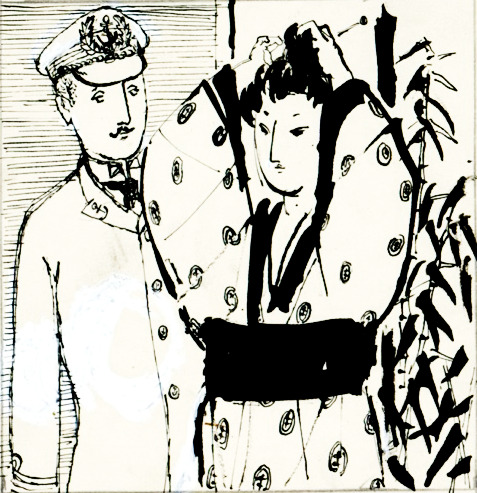
The basics
Music by Giacomo Puccini
Words by Luigi Illica and Giuseppe Giacosa
Based on the play by David Belasco and the story by John L. Long
Language: Italian
Premiere date: Feb 17, 1904
One-liner
A 15-year-old Japanese girl devotes herself to her absent American husband—only to discover, after years of waiting, that he married another woman while abroad. — San Francisco Opera

Buy a print from his shop!
Themes
- sex tourism and (teen) sex trafficking
- American imperialism and postcolonial exploitation of Japan
- Amerasians / war children / GI babies
- Can the subaltern speak? If not, can she sing?
- Transience vs. permanence
Composer

Composer Giacomo Puccini (1858–1924) is often considered the last great genius of Italian opera. Other composers of his era and beyond wrote hit shows, but nothing like his mid-career grand slam of La bohème (1896), Tosca (1900), and Madama Butterfly (1904), all co-created with playwright Giuseppe Giacosa (1847–1906) and poet Luigi Illica (1857–1919)… in addition to the orientalist fantasy Turandot (left unfinished at his death in 1924).
Although we think of the United States as a latecomer to opera, Puccini is actually modern enough that the Metropolitan Opera itself gave the world premiere of one of his later works, the American frontier thriller La fanciulla del West (1910), which features a bunch of cowboys with names like Dick Johnson singing, amusingly, in Italian.
Puccini’s career is filled with textbook examples of the verismo (“realism”) movement in Italian opera, which features sweeping, swooning, melodramatic music and storylines focused on the intense (often violent) passions of working-class people, rather than gods, kings, or heroes. When people close their eyes and imagine “opera,” the sounds and images that come to mind are quite likely to be Puccini’s. “Nessun dorma,” “O soave fanciulla,” “O mio babbino caro”… almost every one of his shows contains at least one showstopper aria of such exquisite melodic beauty that it’s transcended its original context and become iconic. Tosca has arguably one for each of the three main characters! And when he knows he has a good melody, Puccini is not shy about milking it. For climactic phrases, the whole orchestra will play together on the exact same notes as the singer.
Creation
[My research here is based on essays by Chadwick Jenkins, Catherine M. Miskow, Kasper van Kooten, and the Education team at the Metropolitan Opera.]
Like many operas, Madama Butterfly emerged from a stew of sources and influences.

One lineage comes from the French naval officer Louis-Marie-Julien Viaud (1850–1923), who wrote prolifically about his adventures abroad, first anonymously and then under the pen name Pierre Loti. From Istanbul (1879) to Tahiti (1880) to Senegal (1881) to Vietnam (1883) and beyond, Loti published his stories while still in the service, which got him into trouble for recounting French war crimes at the Battle of Thuận An. His Tahitian novel Le Mariage de Loti was widely popular and inspired two operas (Lakme and L’île du rêve).
But today we focus on Japan. From July–August 1885, Loti spent a month in Nagasaki, living with his friend/lover(?) Pierre Le Cor and a local teahouse geisha whose name is variously given as O-Kane or O-Yuki. In 1887 when Loti published his account of this period, Le Cor became “Yves” and the young woman became “O-Kiku” or “Miss Chrysanthemum,” giving the 1887 novel its title: Madame Chrysanthème. In the book, Loti hires this Kiku through a broker, officially marries her, and rents a house high in the hills above Nagasaki harbor, away from the typical foreigner neighborhoods, but she well understands the transactional nature of their relationship — indeed there is little romance between them, and when Loti departs at the end she doesn’t say goodbye while counting her payment. Meanwhile Loti thinks of her as a “little doll” or “trinket.” Once his ship has set sail, he tosses overboard a lotus flower picked from their garden, asking the goddess Amaterasu Omikami to wash him clean of “this little marriage.”
Loti’s novel was adapted into an opera in 1893 by André Messager, retaining the title Madame Crysanthème, which is rarely performed today — although one interesting Japanese-language production took place in Tokyo in 2021 (and was recorded)!
After seeing the opera, another French orientalist, Félix Régamey, responded to the offensive and inaccurate elements of Loti’s story by publishing his own rewrite, Le Cahier Rose de Madame Chrysanthème (The Pink Notebook of Madame Chrysanthemum) in 1894. Régamey’s short book reimagines the story from the woman’s perspective, making her the daughter of a samurai who died by suicide when he could not find a place in rapidly modernizing Japan. This version brings us inside the complex stew of emotions — loyalty, pride, shame, resentment — simmering inside the abandoned geisha, building to her own climactic suicide attempt.


The other creative lineage for Madama Butterfly begins as an anecdote shared by American Methodist missionary Jennie Long Correll, who spent the 1890s with her husband in Nagasaki. On an 1897 visit home to the US, Jennie told her brother John Luther Long about a “dear little teahouse girl” named Cho-san who had been deserted (along with her baby) by her lover, and who opened her paper shoji walls to watch the harbor in vain for the promised signal of his return. “The author in him knew where to take hold of that little story,” she says, and in 1898 Long published the 18-page story “Madame Butterfly” in Century magazine. Here the familiar characters appear: B.F. Pinkerton the heartless American exploiter, and Cho-Cho-san the desperately naïve daughter of a dishonored family who believes they are really in love. Long’s story may be painful reading today (when Cho-Cho-san decides to embrace her new American identity and speak only English, the text really leans into her thick accent), but as Kasper van Kooten argues, Long can be read as critiquing Pierre Loti by centering his sympathies on the Japanese girl and depicting the Western man as an “immoral, indecent colonialist.”
Long’s story was then adapted to the New York stage by writer/impresario David Belasco, whose one-act play Madame Butterfly premiered on March 5, 1900. Belasco’s play is a character study of Cho-Cho-san: set entirely in her home after Pinkerton has already left, it explores the consequences of his absence. A few months later, the play was staged in London, where Giacomo Puccini was in town to supervise the British premiere of Tosca, and he attended a performance. Despite his limited English comprehension, the play moved him to tears — particularly a long wordless “vigil” scene where Cho-Cho-san and her young son stay up all night to “watch for Papa” through holes poked in the paper wall of their home, while Belasco’s innovative lighting techniques mark the transition from evening to morning. According to Belasco, Puccini ran backstage after the show and begged for the rights to adapt the show — and “I agreed at once… because it is impossible to discuss arrangements with an impulsive Italian who has tears in his eyes and both arms round your neck.”
To flesh out the tenor role, Puccini’s longtime librettists Giuseppe Giacosa and Luigi Illica ended up pulling from Long’s short story as much as from Belasco’s play. Perhaps they also (consciously or unconsciously) took ideas from the Chrysanthème material as well. The result is, as Miskow writes, “a mosaic of French criticism, American desire for dominance in the Far East, and Italian dramatic sensibility.” Puccini himself, whose composition process was delayed by a near-fatal car crash, threw himself into researching Japanese art and music and was very proud of incorporating several folk melodies from Japan (and, as recently discovered, from China) as major motifs in the opera. For a lengthy discussion of this topic, see Kunio Hara’s 2003 thesis “Puccini’s Use of Japanese Melodies in Madama Butterfly.”
The premiere of Puccini’s Madama Butterfly, held February 17, 1904 at the Teatro alla Scala in Milan, was a shocking disaster, essentially booed off the stage. While the show had some structural problems, the main culprit may have been a cutthroat business rivalry: the famously partisan audiences at La Scala had their metaphorical knives out for Puccini in order to support his publisher’s rival Edoardo Sonzogno. Puccini was utterly humiliated, canceled the rest of the run, and vowed never again to trust La Scala with a premiere. The creators then made structural changes to the show, including breaking up the long second act, and within a few months (May 28, 1904) the revised Butterfly was staged in Brescia to huge acclaim (Puccini received ten curtain calls). It went on to conquer the world, with additional tweaks throughout 1907 establishing its final form.
This network of credited and uncredited contributors — all Westerners writing for Westerners, and nearly all men — created an international melange about international melange, full of immense beauty and great injustice. And audiences have been responding ever since.
Reception and Afterlife

Butterfly has spent more than a century as one of the most beloved operas of all time — today, Operabase data ranks it in the top 10 worldwide, with over 17,000 performances logged. At the same time, its content has raised serious challenges over the years. While the opera centers its sympathy on Cho-Cho-san and her cruel treatment at the hands of Pinkerton, some audiences find that Butterfly itself gets caught in the same pattern of condescension and dehumanization that it wants to condemn. Puccini’s gorgeous music tempts us to accept the perspective of the characters — Pinkerton’s infatuation with his “doll-like” new wife, or Cho-Cho-san’s deluded romanticization of their relationship — and softens any critique that the show might be making. It transforms a horrifying situation into a lovely night at the opera.
British media exec and opera commentator Denis Forman, hardly the poster child for cultural sensitivity, wrote in A Night at the Opera (1994): “the main drawback is that Puccini’s Japan is seen as a tragi-comic Third World country where funny little people have quaint little customs. All right before the imperialist ethos was smashed to smithereens but today it is Puccini, Illica and Giacosa that look rather funny and ignorant little men.”
This places the opera industry in an interesting bind: how to handle these issues responsibly without throwing away one of the greatest crowd-pleasers and money-makers in the catalog? Believe it or not, this dilemma… comes up a lot in opera.
I can’t address it all here, but let me share one specific example that seems especially ambitious. Boston Lyric Opera planned to stage Butterfly in 2020, but delayed it twice: first because of COVID-19, then again in response to a wave of anti-Asian hate crimes. When the show finally premiered in 2022, it was part of The Butterfly Process, a lengthy series of panels, articles, and public conversations coordinated by dancer/director/activist Phil Chan, to examine all these issues through Asian perspectives and in the context of broader racial reckonings.
Setting

by Utagawa Kunisada and Utagawa Hiroshige II, 1861.
Nagasaki, Japan, in the present day according to the 1904 libretto.
The city of Nagasaki was created in 1571 by Portuguese missionaries and merchants, authorized by Ōmura Sumitada (the first daimyō to convert to Christianity), specifically as a seaport for trade between Japanese and European communities. For centuries it was the only such port in Japan, and as a result it grew into a cosmopolitan crossroads as well as a nexus of intercultural conflicts — although Japan under the Tokugawa shogunate was largely isolationist.

After the Meiji Restoration of 1868, Nagasaki rapidly industrialized along with the rest of the country, and Japan became increasingly connected with European and especially American forces.
At the point of Madama Butterfly’s creation, both Japan and the U.S. are still finding their feet as world powers, with cordial relations between them, although tensions will soon build over immigration and Pacific islands such as Hawaii and the Philippines.
Characters

based on a 2008 novel by Shinichi Ichikawa.
- Cio-Cio-san (蝶々さん) aka Madama Butterfly, a teenage geisha (soprano)
- B. F. Pinkerton, a U.S. Navy lieutenant (tenor)
- Suzuki, the maidservant to Cio-Cio-san (mezzo)
- Sharpless, the U.S. consul in Nagasaki (baritone)
- Goro, a marriage broker (tenor)
- the Bonzo, a Buddhist priest/monk and Cio-Cio-san’s uncle (bass)
- Kate, an American woman who marries Pinkerton (mezzo)
- Prince Yamadori (baritone)
- The Imperial Commissioner (bass)
- The Registrar (bass, baritone, or tenor)
- Yakusidé, an uncle of Cio-Cio-san (soprano)
- Cio-Cio-san’s mother (mezzo)
- Cio-Cio-san’s aunt (soprano)
- Cio-Cio-san’s cousin (soprano)
- Various relatives and friends of Cio-Cio-san, servants, sailors, etc (chorus)
Libretto

- You can download and read the full libretto here:
- Italian/English PDF libretto associated with the 1974 Karajan/Decca recording.
Note: Puccini, like most composers by the dawn of the 20th century, structured this opera as a fairly continuous music-drama, each moment flowing into the next without the clear boundaries that characterized earlier eras. As a result, the slicing of each act into individual CD tracks is a subjective decision, and different editions will slice them differently (even in the same recording!). This can be confusing until you know the opera well, which is why I always try to recommend a libretto booklet paired with its corresponding album as closely as possible. Just one of those quirks of opera fandom.
Audio Recordings
Since Madama Butterfly is such a global smash hit, there are many recordings, and many of them are beloved!
For our purposes, let’s go with the one declared “untouchable” by critic Ralph Moore, conducted in 1974 by Herbert von Karajan for Decca, starring Mirella Freni and Luciano Pavarotti: “the slow speeds and lush playing wring every ounce of emotion from Puccini’s score and the singing is divine… Pavarotti does the impossible by making that irredeemable swine Pinkerton dashing, alluring, charming and sympathetic; the sheer bravura of his singing suspends our judgement.” Alexandra Wilson says “Freni, so often the Puccini soprano par excellence, is perfect here, exuding immense tenderness but without feigned childishness.” And Gramophone calls the whole recording “radiant” and “ravishing to the ear.”

Our selected recording: 2 hr 25 min, conducted by Herbert von Karajan in 1974 in Vienna.
- Starring Mirella Freni (Cio-Cio-san) and Luciano Pavarotti (Pinkerton)
- Stream the audio: apple | amazon | idagio | spotify | tidal | youtube.
- The track-by-track breakdowns below use the numbering from this recording, split across 3 discs.
Sometimes you don’t want to listen to an entire opera but just get familiar with the best parts. In that case, I’m recommending the 1-hour “highlights” selection below on RCA conducted by Erich Leinsdorf, which also has the benefit of an American tenor (Richard Tucker) to play the American soldier Pinkerton. He’s joined by a fellow American (the legendary Leontyne Price), so that relationship doesn’t have an international element, though it is interracial. [The issue of ethnicity in opera casting is a topic too vast and contentious to address here: see the bottom section of this guide for some starting points. Instances of Japanese sopranos playing Cio-Cio-san are pretty few and far between, and not released in album form — though there are some video recordings, e.g. Yasuko Hayashi in 1986 and Hiromi Omura in 2014.]

A one-disc highlights album: 1 hr 3 min, conducted by Erich Leinsdorf in 1962 in Rome.
- Starring Leontyne Price (Cio-Cio-san) and Richard Tucker (Pinkerton)
- Stream the audio: apple | amazon | idagio | spotify | tidal | youtube.
- I have marked the tracks featured on this disc with green highlighter below.
Scene-by-Scene Breakdown
Act One
A house, terrace, and garden on a hill near Nagasaki.

Albert Carré’s production at the Opéra-Comique, Paris, 1906
1.1) [Introduction] – E soffitto e pareti – 2:54
US Navy Lieutenant B.F. Pinkerton takes a tour of the house he’s just rented for himself and his new Japanese wife. The obsequious broker, Goro, demonstrates how the sliding walls can be moved at will to reconfigure the home’s layout. Goro then introduces the staff, including his wife’s “devoted maid,” Suzuki.
- Right off the bat we’re introduced to key themes: thanks to its lightweight wood-and-paper construction, even the house itself is a temporary arrangement that can be commanded to suit the whims of its American master. Goro describes it as “solid,” but according to Pinkerton it’s “frivolous” and a “casa a soffietto” (a house like an accordion bellows, sometimes translated as “house of cards” or “delicate as a puff of wind”). Will this debate over Japanese architecture also be reflected in Pinkerton’s attitude toward Japanese people? Is this marriage going to be sturdy and lasting, or breezy and insubstantial? Is bending over backwards to accommodate somebody a sign of virtue, or a sign of weakness?
1.2) Sorride vostro onore? – 3:30
Suzuki shares some Japanese wisdom on the virtue of a smile, but Pinkerton ignores her (“empty chattering, as women do around the world”). Goro dismisses the servants and prepares Pinkerton for the marriage ceremony. Sharpless, the American consul, arrives. While Goro fetches drinks, the two Americans chat and enjoy the hilltop view. Pinkerton has rented the house for 999 years but can cancel at any time — “in this country, houses and contracts are equally flexible.”
- Foreshadowing!! What other kind of contract is Pinkerton about to sign today?
1.3) Dovunque al mondo – 2:58
Pinkerton celebrates the life of the wandering Yankee, roaming the world, laying anchor in random places until stormy weather comes, collecting the flowers of every land and the heart of every beautiful girl. In short: doing whatever he wants. Sharpless calls this an easy gospel, one that leads to a life of pleasure but a sad heart.
1.4) America for Ever – 2:34
Pinkerton and Sharpless drink a toast to America. Pinkerton admits he is infatuated with his bride — she is light and delicate like blown glass, carries herself like a painting on a screen, flutters gracefully like a butterfly. He must chase her, even if he crushes her wings.
- Not only do the two Americans briefly break into the English language for their toast (which raises awkward meta-questions about what language they’re supposed to be using for the rest of this Italian opera), Puccini really underscores the point by setting it to the melody of “The Star-Spangled Banner.” Like I said, he’s not the most subtle composer.
1.5) Ier l’altro il Consolato – 2:08
Sharpless tries to caution Pinkerton: yesterday he overheard her at the Consulate and was touched by the sound of her voice, which sounded like true love. To break such a trusting heart would be a great sin. That heavenly little voice should not sing notes of sorrow! Pinkerton dismisses the older man’s advice and pours another toast, to his family overseas and the “real American wife” he will marry someday.
- Here the team is deploying a classic theatrical trope of building up our expectations for a main character before we meet her. My favorite example is Verdi’s Otello, but there are plenty more. And of course, since this is an opera, all of Sharpless’s praise for Butterfly’s divine voice carries extra meaning. She’d better be pretty special, if she’s had this kind of effect on a guy just from overhearing her!
1.6) Ecco. Son giunte al sommo del pendio – 3:43

Goro excitedly announces the arrival of the bridal party coming up the hill. We first hear the voices of Butterfly’s friends ooh-ing and ah-ing over the view, then the bride herself, rapturously happy about reaching “the threshold of love.” The friends encourage her to turn and look at the sky, the flowers, and the ocean before crossing that threshold. As they finally come into view, she points out the groom to her friends and they all kneel.
- After that setup from Sharpless, we now get some of the most sumptuously beautiful entrance music in the history of opera to set the tone for the title character’s arrival.
- Puccini may be taking a cue from the idea of climbing a hill, as the music here suggests reaching new heights that provide strange new vistas of worlds never before seen, each step taking us further and and further into the unknown.
- One touching detail at the end of this track is the way Butterfly carefully articulates the name “F. B. Pinkerton,” even when sung by an American soprano like Leontyne Price or Maria Callas, because Puccini specifies that the line be sung “molto stentato” (very strugglingly). Regardless of the singer’s nationality and the Italian libretto, this moment shows a Japanese girl working hard to pronounce an American name, presumably after practicing at home, and still having a hard time with it. She accidentally inverts the order of his initials, a common issue when moving between Japanese and Western naming conventions. But it’s important to her to demonstrate that she can say his name. I’m reminded of the moment in Der Rosenkavalier (1911) when another young bride-to-be, Sophie, demonstrates how hard she has worked to memorize all the names of the noble family she’s marrying into. Names and name-changes have long been a charged symbol for girls as they contemplate losing their maiden identity and becoming linked to a husband’s family in a very real and legally binding sense.
1.7) Gran ventura – 3:52
Bride and groom greet each other. Sharpless asks Butterfly about her family, and she explains that although they were once wealthy, hard times have them to become geishas to support themselves. Her father is dead, and the girl herself is fifteen — “already old,” she laughs. The two Americans remark on her age: Sharpless calls it “the age for games,” Pinkerton “and for confetti” (sugar-coated almonds, a traditional Italian wedding treat).
- Butterfly’s conversation with Sharpless has many implications. When he asks her age, she challenges him to guess, which reminds us that she’s trained not to be totally submissive, but to be charming. On the other hand, his guesses are disturbing: first 10 years old, then 20. Does she really look like a 10-year-old girl? Is Sharpless that baffled by Japanese features or geisha makeup? Are these guys treating Japan like one big Epstein Island?
1.8) L’Imperial Commissario – 3:32
Goro announces the arrival of more wedding guests, including the Imperial Commissioner, the Registrar, and many of Butterfly’s relatives, who gossip about the groom. In the general hubbub, Sharpless warns Pinkerton against breaking the heart of this beautiful flower.
1.9) Vieni, amor mio! – 2:52
Pinkerton shows Butterfly the house, where she unpacks her very few possessions (from the sleeves of her kimono). When he complains about her jar of makeup, she instantly throws it away. Only one item she refuses to explain (too many people around): a long narrow box. Goro privately whispers to Pinkerton that it’s the sword sent by the Mikado (emperor) to command her father to commit suicide, which he did. Finally, she unpacks several hotoke (仏), small figures representing the souls of her ancestors. Pinkerton is clueless but respectful.
1.10) Ieri son salita tutta sola in segreto alla Missione – 2:14
Butterfly makes a confession to Pinkerton. Yesterday she snuck out to the Mission and joined the church, unbeknownst to her family, including her uncle who is a Bonze (Buddhist priest). She intends to follow her destiny and humbly kneel beside her new husband in his church, praying to his God.
- As Butterfly describes this act of submission to the same God as signor Pinkerton, she uses the melody described in this New York Times article — a Chinese folk tune known as 十八摸 (shí bā mō) or “Eighteen Touches,” a bawdy song recounting the various parts of a woman’s body where a man might touch her. This melody will return later, always linked to Butterfly, her relationship with Pinkerton, and her new identity as belonging to him.
- The story of W. Anthony Sheppard rediscovering this tune in 2012 from a Swiss music box in a New Jersey museum is pretty juicy for those of us with Indiana Jones fantasies; he later expanded it into a journal article if you’re curious.

1.11) Tutti zitti! – 3:12
The wedding ceremony begins. The Imperial Commissioner reads a proclamation, Goro prompts the bride and groom to sign the contract, and it’s over. Butterfly’s friends celebrate her by name, but she playfully corrects them: “Madama F.B. Pinkerton.” The officials made their departure, with a few parting wishes to Pinkerton — from the Registrar, “posterità” (children), and from Sharpless, “giudizio” (good judgment). Pinkerton is left with his new relatives and several bottles of sake.
1.12) O Kami! O Kami! – 0:36
Pinkerton and the in-laws drink a series of toasts.
1.13) Cio-cio-san! Cio-cio-san! – 2:44

Suddenly an angry, authoritative man approaches — Butterfly’s uncle, the Bonze. He knows that she has renounced the ancient ways and converted to Christianity, and yells in her face about it, invoking the Shinto deity Sarutahiko Ōkami. Pinkerton steps in to cut him off, so the Bonze persuades the relatives to leave, all condemning her as they exit.
- Some of this language seems like a pretty inauthentic way to talk about Japanese religion, framing it in very European terms, although whether that’s from ignorance or an attempt to be accessible to their Italian audience, who’s to say.
- I’ve seen some suggestions that the Bonze is also offended by the party atmosphere: perhaps the drunken revelry also reflects the corrupting influence of Western culture? If true, that would lend an extra hypocrisy to the family’s abrupt pivot — they distance themselves from Butterfly to avoid facing condemnation themselves. On the other hand, I hear Puccini’s music for the sake toasts as pretty restrained and reverent, not boisterous.
1.14) Bimba, bimba, non piangere – 2:20
Pinkerton comforts his new wife as she weeps: “all the Bonzes in Japan aren’t worth a tear from your beautiful eyes.” From inside they hear Suzuki the maid saying her evening prayers.
1.15) Viene la sera – 7:32
Evening approaches. Butterfly — rejected by her family, but happy — goes into the house to change from her fancy wedding dress into a white robe. Pinkerton watches, inflamed with desire. They discuss their intense emotions.
- Butterfly’s text here is fairly ambiguous, leaving Puccini’s music and the soprano’s performance to tell us how she feels from moment to moment. It seems clear that she’s cycling through fear and excitement, mostly focused on her new husband but sometimes struggling with her family’s rejection, with hints of uncertainty about what she just got her self into, and even fear of her own overwhelming feelings.
1.16) Vogliatemi bene – Vieni, vieni! [Love Duet] – 7:52
Butterfly kneels at Pinkerton’s feet and asks him to love her with a small love, like a child, as is appropriate for her. “We are a people accustomed to small things; modest, quiet things; a gentle tenderness as profound as the sky and the ocean.” She mournfully observes that men who catch butterflies pierce them with a pin. Yes, says Pinkerton, to stop them from flying away. He claims her as his, and she agrees — his, for life. They marvel at the starry sky which “laughs with the ecstasy of love” and enter their new house.
- Somebody could write a whole book trying to unpack everything going on in this scene. I’m struck by the way it involves the specific intersections of race, gender, wealth, and other privileges while also invoking the universal emotions of any couple during a transcendent change, whether on their wedding night or not. Do you feel the swooning beauty of falling in love and surrendering to ecstasy, or the bitter cynicism and dread of how this moment is built on a rotten foundation and will end in misery? If the team plays their cards just right, maybe you’re feeling all of the above in an exquisitely bittersweet balance.
Act Two
Inside Butterfly’s house.

17/2.1) E Izaghi ed Izanami, Sarundasico e Kami – 7:35
It’s been a few years since Act One. Pinkerton is gone. Suzuki prays to various Japanese deities (Izanagi, Izanami, Sarutahiko Ōkami, Tenshō Daijin). Their little household is running out of money, but Butterfly is still certain that Pinkerton will come back. After all, he said he would return with the roses, in the warm season when the robins nest. Suzuki doesn’t share her mistress’s confidence.
18/2.2) Un bel dì vedremo – 4:32
Butterfly, with utter conviction, vividly describes how it will happen: the beautiful day when his ship comes in. The ship will signal, she will wait on the hilltop, Pinkerton will climb to the top and call her name. She will hold back at first — partly to tease him and partly so she won’t die of happiness — until he calls out his pet names for her, “piccina mogliettina” (little wifey) and “olezzo di verbena” (verbena scent), like he used to. This will all happen. Her faith is sure.
- Here it is — the #1 showstopper of the night! For a lengthy examination of this aria, see the Aria Code podcast episode “Puccini’s Madama Butterfly: When My Ship Comes In.”
- Notice the big high-pitched money notes are on the words “morire” (to die) and, a minute later, “l’aspetto” (I await it). Each moment works brilliantly in isolation, but when considered together there’s an additional, more ominous layer.
19/2.3) C’è. Entrate – 6:38

Goro escorts Sharpless up the hill, then leaves him alone with Butterfly, who proudly welcomes him to “an American house.” Sharpless tries to talk to her about a letter he’s received from Pinkerton, but keeps getting interrupted. She asks whether American robins perhaps nest less frequently than in Japan, because here they’ve nested three times already. Sharpless politely responds that he’s not an ornithologist. Butterfly complains that Goro is trying to find a new Japanese husband for her, and Goro pops in to defend his actions, because she is out of money. The wealthy new suitor, Prince Yamadori, arrives carried by servants. He desires her intensely — has divorced all his previous wives to commit himself to her — but she refuses. By American law, Butterfly insists, she is still married.
20/2.4) Si sa che aprir la parta – 1:04
Butterfly goes on about how Americans take marriage more seriously than the Japanese, and gets Sharpless to awkwardly back her up on this point.
21/2.5) Udiste? – 2:01
The three men (Sharpless, Goro, and Yamadori) quietly discuss Butterfly’s unfortunate stubbornness. Sharpless’s ship is already entering the harbor, and they know his return will crush her. Prince Yamadori makes two more attempts to broach the subject with Butterfly, but she won’t hear of it, so he sighs and departs. Goro follows.
22/2.6) Ora a noi. Sedete qui – 2:56
Sharpless, alone with Butterfly again, finally presents the letter he received from Pinkerton. He reads it aloud, though constantly interrupted by her excited misinterpretations.
23/2.7) Ebbene, che fareste, Madama Butterfly? – 2:53
Sharpless gives up on the letter and cuts to the chase: what if Pinkerton never comes back? Stunned, Butterfly considers two possibilities: she could go back to singing at the teahouse, or she could (and probably would rather) die. Sharpless, in great agitation, urges her to accept Yamadori’s offer. Butterfly is so devastated that she almost kicks him out of the house — then changes her mind and steps away into the bedroom.
24/2.8) E questo? E questo? – 2:27
Butterfly returns holding a young boy with blue eyes and golden hair: Pinkerton’s child. Write to Pinkerton, she says, and let him know about this boy. Then he’ll come.
25/2.9) Che tua madre dovrà prenderti in braccio – 5:17

Butterfly performatively “tells” her son that this heartless man (Sharpless) wants her to humiliate herself by begging through the city, singing and dancing as a geisha. Never! I would rather die than dance again. Sharpless, moved to tears, asks the child’s name. Butterfly says he’s currently named Dolore (Sorrow) but that meeting his father will change his name to Gioia (joy). Sharpless exits, promising to tell Pinkerton.
- I’m struck by the way this scene realistically nails the way adults can use small children or pets in a sort of ventriloquist act, indirectly talking to another adult but using the little one as a go-between. It happens twice in two different ways!
26/2.10) Vespa! Rospo maledetto! – 2:01
Suzuki hauls Goro inside: this “vampire” has been saying that in America, children without fathers are treated as outcasts. Butterfly pulls the blade from the shrine and chases Goro out. She reassures the boy that his “avenger” will come and take them far away to his country. Suddenly they hear a cannon in the harbour.
- Here’s the second appearance of her father’s sword.

The child is a bunraku-inspired puppet controlled by three black-clad puppeteers.
27/2.11) Una nave da guerra – 2:44
Butterfly looks through her telescope to read the ship’s name — Abraham Lincoln: Pinkerton’s ship! Just when everyone was telling her to give up hope, her love and faith have triumphed.
- We’re now firmly in the zone of agonizing dramatic irony, since we the audience (like every single character except Butterfly) know what she refuses to recognize.
- In case you’re wondering, at this time the US Navy did not yet have a ship named the Abraham Lincoln. A German civilian steamer by that name was built in 1907, but not seized for American military use until 1917.
28/2.12) Scuoti quella fronda di ciliegio – 5:38
She commands Suzuki to pick all the flowers in the garden to decorate the house. All the flowers? The garden will look totally bare! Yes, all the flowers. Spring must dwell inside the house. As full of flowers as the night is full of stars. They arrange the flowers in vases and toss petals all over the room.
- This “Flower Duet” is another beloved moment that’s sometimes excerpted, as on this recording by Montserrat Caballé and Shirley Verrett, but don’t confuse it with the even more popular flower duet from Léo Delibes’ Lakmé (1883).
- The final flower named in this list is the one Butterfly mentioned earlier as his pet name for her (track 18 above) — verbena.
29/2.13) Or vienmi ad adornar – 5:34
Suzuki helps Butterfly with her hair and makeup. Butterfly even applies some rouge to the boy’s cheeks. She puts on the ceremonial robe and obi that she wore on their wedding day, so she can look just the way he remembers. Finally, they slide the paper shosi closed and Butterfly pokes three holes in it at their different eye-levels.
- The Opera for Everyone podcast points out that with their money running out, this family may not have been eating well, so her anxiety about them looking pale and hollow is extra poignant.
30/2.14) Coro a bocca chiusa [“Humming Chorus”] – 3:02
As night falls, Butterfly, Suzuki, and the little boy look out through their respective holes in the shosi. We hear voices humming wordlessly outside.
- What is going through her mind? Does Puccini’s music tell us? Or is the music only commenting on her from outside, leaving the inside a mystery?
- Maybe a biased question because I’m leaning toward the latter. There’s an operatic tradition of hearing an anonymous offstage chorus in quiet nocturnal moments of great personal anguish, as an interlude contrasting the harmonious togetherness of the community with the haunted loneliness of the onstage character. The music is happy and peaceful, but we’re looking at somebody who’s deeply unwell. I’m thinking of the song of the nightwatchmen ending Act One in Strauss’s Die Frau ohne Schatten (1919), but I’m sure there are other examples that I can’t think of at the moment.
Act Three (or Act Two, Part 2)

31/3.1) [Intermezzo] – Oh eh! Oh eh! – 6:13
The child and Suzuki fall asleep. Butterfly remains upright, as still as a statue, gazing through her hole all night long. Eventually we hear the distant voices of sailors heaving cargo in the harbor. Dawn is coming.
- Remember, this long all-night vigil is the scene in David Belasco’s play that hit Puccini like a ton of bricks and inspired him to want to write this opera.
- Maybe now, in this five-minute instrumental intermezzo, is where Puccini attempts to wordlessly tell us how Butterfly is feeling?
32/3.2) [Fischi d’uccelli dal giardino] – 1:49
As the sun rises, birds begin to chirp and Suzuki wakes up.
33/3.3) Già il sole! – 2:16
Suzuki tells Butterfly to get some sleep. Butterfly goes offstage and puts the kid to bed with a lullaby.
34/3.4) Chi sia? – 2:48
Pinkerton and Sharpless arrive and speak quietly with Suzuki. Pinkerton is surprised to hear that they knew his ship had arrived, but Suzuki explains that Butterfly has spent the last three years examining every single ship that enters Nagasaki harbor. Suzuki notices a strange woman waiting outside. Sharpless explains it is Pinkerton’s wife, and he asks Suzuki to help them through this terribly uncomfortable situation.
35/3.5) Io so che alle sue pene – 2:09
Sharpless feels very sorry for the mother’s grief, but it’s important to secure the child’s future. This compassionate woman outside will be a good mother to him. In fact, let’s bring Butterfly out so she can see the truth for herself. Meanwhile, Pinkerton looks around the room and feels increasingly upset as he gradually realizes how Butterfly has been feeling all this time. Suzuki is overcome by the tragedy.
- This trio is a great example of that glorious operatic tradition, the ensemble, where multiple lead characters (of different voice types) all pause to reflect on a crazy situation, each with their own different texts and distinct perspectives, voices overlapping and weaving around each other in counterpoint. This makes the text harder to comprehend in the moment, but the performance should make it absolutely clear how each character is feeling, even if you just listen to the music.
36/3.6) Non ve l’avevo detto? – 1:54
Pinkerton, flooded with guilt, tries to leave the room. Sharpless reminds him: I specifically warned you to be careful with this girl, remember?! Pinkerton finally sees his mistake: “I shall never be free from this torment.”
37/3.7) Addio, fiorito asil – 3:09
Pinkerton sings a haunted farewell to this “flowery refuge of happiness and love,” with occasional mournful comments from Sharpless. Pinkerton can’t bear to stay here any longer and must flee: “I am vile.”
- As Keely Herron says on the Opera for Everyone podcast: “He might be vile, but… he can sing.”
- This aria was not part of the (much-booed) premiere production at La Scala — the team added it as part of thei revisions, to give the tenor one last showcase to show his remorse.
Suzuki returns with Pinkerton’s new wife, Kate, who promises to care for the boy like a son. Suzuki believes her, but asks her to wait outside.
38/3.8) Suzuki! Suzuki! Dove sei? – 1:55

Butterfly enters and asks for Pinkerton, searching the house frantically when he does not appear. She wonders who the woman outside is. Nobody answers.
39/3.9) Tu, Suzuki, che sei tanto biona – 5:31
Butterfly demands answers from a weeping Suzuki, who can barely respond, but she gradually puts the pieces together. Pinkerton is alive. But he’s not coming back. That woman is his wife. It’s all over for me. They want to take my son. Sharpless urges her to be brave and do it for the good of the child. She complies — “I must obey him.” Kate calls out from the garden: Can you forgive me? Butterfly wishes her well. She will give the father his son, if he comes to pick him up, half an hour from now. The Americans leave.
40/3.10) Come una mosca prigionera – 2:57
Butterfly asks Suzuki to close all the windows and leave her in darkness (“too much light and too much spring”), then orders her to go join the boy playing outside. She kneels before the altar, removes its white veil, then picks up her father’s blade.
41/3.11) Con onor muore – Tu, tu, piccolo iddio! – 5:34
Butterfly solemnly kisses the blade and recites the text inscribed on it: “One dies honorably / who can no longer live honorably.” As she prepares to slice her throat, Suzuki pushes the child through the door towards his mother. Butterfly puts the sword down and embraces him passionately: My love, my lily and rose flower, it is for your sake that Butterfly dies, though you must never know it and never feel the pain of abandonment. She gives him an American flag and a doll to play with, then ties a blindfold over his eyes. With eyes fixed on the boy, she picks up the sword and retreats behind a screen, then after a moment, staggers out with the white veil around her neck to embrace him with her last strength. Pinkerton and Sharpless burst into the room as Butterfly gestures feebly to the child and dies.

Further reading
Mark Rudio has a 2017 essay on “Madame Butterfly in the Trump Era”:
Is it possible for contemporary audiences to watch Butterfly now and not feel the lurking shadows of sex tourism, Boko Haram, honor killings, Bill Clinton, Bill Cosby, Bill O’Reilly, Roger Ailes, and yes, the current President of the United States, especially when one of its main characters might as well be one of his sons, a transactional chip off the ol’ Trump block, out for all he can get?
To the above I would only add the unavoidable name of Jeffrey Epstein, and what his network of teen sex trafficking has revealed about the impunity of the privileged men who roam across the earth taking what they want, like the “Yankee” celebrated by Pinkerton’s first aria.
Educator guides for Madama Butterfly are available from Atlanta Opera (2020), the Metropolitan Opera (2023), and Kennedy Center Education (2006).
Madama Butterfly cast a long shadow over Western ideas about Asian people and gender, particularly manifesting in the late 1980s for some reason. In 1988, David Henry Hwang’s play M. Butterfly fictionalized the real relationship between a French diplomat and a Beijing opera performer who passed as female for 20 years during the Cold War. In 1989, Alain Boublil and Claude-Michel Schönberg finally followed Les Miserables with Miss Saigon, a re-imagining of Madama Butterfly about a young Vietnamese woman left pregnant by a U.S. Marine.
For more on ethnicity and casting in opera, you can start with two articles by Anne Midgette in the Washington Post: “Talking race and ‘blackface’ in opera” (a roundtable discussion from 2015) and “In theater and film, we demand that Asian roles be played by Asian actors. Why is opera different?” (from 2017), as well as the 16-minute TIME Magazine documentary Beyond Butterfly: How an Asian American Opera Singer Found Her Voice Amid a Reckoning with Race (2022) featuring Nina Yoshida Nelsen.
Leave a Reply