
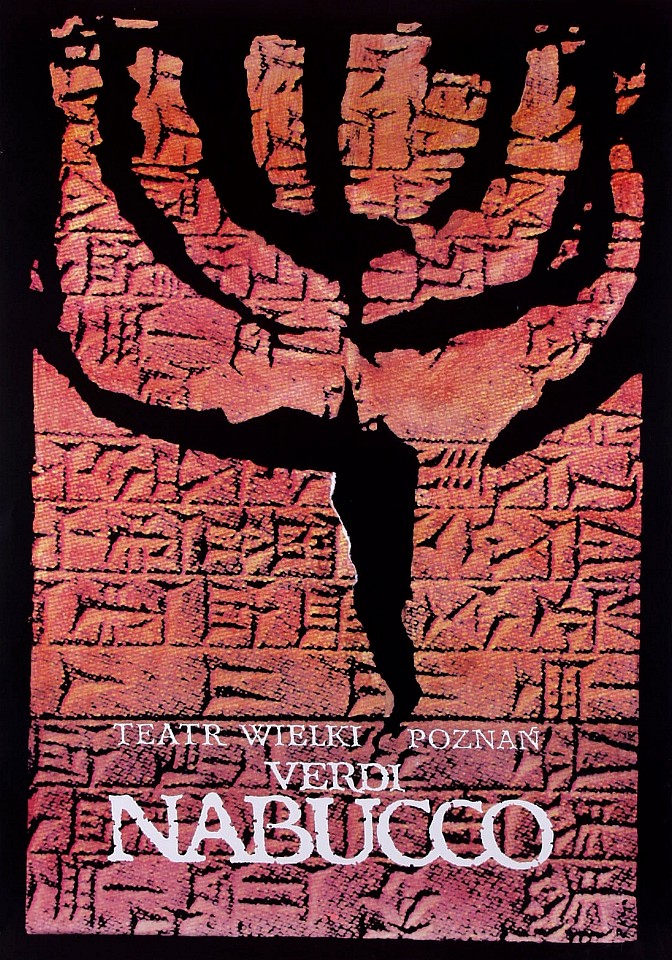
The basics
Nabucodonosor, commonly abbreviated to Nabucco
Music by Giuseppe Verdi
Words by Temistocle Solera
Premiered March 9, 1842
Teaser
Politics. Religion.
Nabucco is Verdi’s retelling of the Old Testament story
of King Nebuchadnezzar II’s religious conversion.
On one side, the fiery Hebrew priest Zaccaria, battling to lead his people from oppression.
On the other, Nabucco, the tyrannical Babylonian king and his adopted daughter Abigaille,
who will stop at nothing to get her father’s throne and her sister’s lover.
Will King Nabucco’s ambition rob him of his beloved daughter as well as his kingdom?
—OperaVision/Grand Théâtre de Genève, 2023

Themes
- Human beings in a mob
- What’s a mob to a king?
- What’s a king to a god?
- What’s a god to a nonbeliever?
- Identity: a matter of birth, or of choice?
- Adoption, succession, conversion
- Father/daughter relationships
- Nationalism: Hebrew, Italian, etc
- Romantic love vs national loyalty
Source material
Based on:
- the life of Nebuchadnezzar II (King/Emperor of Babylon 605–562 BCE)
- the biblical books of Kings, Jeremiah, Lamentations, and Daniel (7th–2th century BCE)
- the play Nabuchodonosor by Auguste Anicet-Bourgeois & Francis Cornu (Paris, 1836)
- the ballet Nabuccodonosor by Antonio Cortese (Milan, 1838)
Setting

PLACE: Part I takes place in Jerusalem, capital of Judah. Parts II-IV are set in Babylon, capital of the Neo-Babylonian Empire and the largest city in the world at the time. So a director just has to stage one of the Seven Wonders of the World as well as the most sacred Jewish relic that magically killed all those Nazis in Raiders of the Lost Ark. No pressure!
TIME: 587 BC — the end of the First Temple period and beginning of the exile in Babylon
CAVEATS: Like most operas, this one takes some creative liberties, both with the Biblical narrative and with the historical record. Aside from Nabucco himself, basically all the characters are invented. The Hebrew prophet character Zaccaria is “a kind of conflation of Jeremiah, who did not go to Babylon, and Ezekiel, who did.” Also, when Nabucco was written in the early 1840s, the modern European study of Babylon was just getting started. Archaeologists had only just begun to excavate the city, and linguists were still working to decipher Assyro-Babylonian cuneiform. But even at the time, this was basically Bible fanfiction: Nabucco himself seems to be a blend of the Babylonian king Nebuchadnezzar, who exiled the Jews and destroyed the first temple, and partly also the Persian king Cyrus the Great, who facilitated the Jews’ return and the construction of the second temple.
Characters

- King Nabucco (baritone), ruler of Babylon, who is at war with the Hebrews
- A fascinating role full of transformations. Even at this early stage of his career, Verdi’s special knack for a morally-ambiguous baritone (often a father figure) is fully evident.
- Abigaille (soprano), eldest daughter of Nabucco and warrior princess of Babylon
- William Berger: “Abigaille is one of opera’s most outstanding bitches, not so much in what she says as in the number of octaves she takes to say it.”
- Fenena (mezzo), younger daughter of Nabucco and sister to Abigaille
- “The sweet one,” to oversimplify things, but there are brief sparks of fire in her.
- Ismaele (tenor), prince of the Hebrews, nephew of King Sedecia of Jerusalem.
- He’s the romantic hero, but Verdi wasn’t very interested in romantic heroes. His story arc is potentially rich, but he’s not given much stage time to work with.
- Zaccaria (bass), high priest of the Hebrews
- As Berger says, you need a guy who speaks with the voice of God: a tall order!
- Anna (soprano), sister to Zaccaria
- Abdallo (tenor), an old and devoted officer of Nabucco
- High Priest of Bel (bass), head of the Babylonian religion
- Chorus: Babylonian & Hebrew soldiers, Levites, Hebrew virgins, Babylonian women, magi, lords, populace, etc. Nabucco relies on its chorus even more than most Verdi operas.
Libretto
Click here to download the libretto from Decca Classics as a text PDF with multi-lingual facing translation.
Audio recordings
Nabucco is not as widely beloved as Verdi’s later masterpieces like La Traviata, Rigoletto, and Aida, but it was his first big hit, and it’s fairly popular to this day. Still, there’s not a huge number of recordings. The role of Abigaille in particular is considered to be a risky voice-wrecker, as indeed it may have been for the very first Abigaille, Giuseppina Strepponi. In the modern era, Muti 1978 starring Matteo Manuguerra and Renata Scotto, or Sinopoli 1983 starring Piero Cappuccilli and Ghena Dimitrova (plus Plácido Domingo in the tenor role), are among the major candidates. A live 1949 recording captures the legendary Maria Callas as Abigaille, but the sound quality is crap.
Fortunately, the best-reviewed version is also the version matching our libretto, so let’s use the 1965 Decca recording conducted by Lamberto Gardelli:

- Length: 1 hr 25 min
- Starring Tito Gobbi (Nabucco) and Elena Souliotis (Abigaille) with Carlo Cava (Zaccaria), Bruno Prevedi (Ismaele), and Dora Carral (Fenena)
- Stream the audio from: amazon | apple | idagio | spotify | tidal | youtube.
Sometimes, rather than listening to a whole opera, you only want to hear the highlights — enough to fill one CD — to get familiar with the music. In this case, since the whole show is only 2 hours of music, this 70-minute disc actually includes more than half of the opera:

- One-disc set of highlights condensed from that same 1965 Gardelli recording.
- Stream the audio from: amazon | apple | idagio | spotify | tidal | youtube
- The passages selected for this highlighits disc are highlighted in green below.
SCENE BY SCENE
Part One: Jerusalem
“Thus saith the Lord:
Behold, I will give this city into the hand of the king of Babylon,
and he will burn it with fire.”
(Jeremiah 32)
1.1) Overture
- The Grove Dictionary of Opera says “The overture, except for the chorale-like opening, is made up of themes from the opera: the main, recurring idea [rapid, nervous, and staccato] is from the ‘Maledetto’ chorus in Part 2; there is also a compound-time, pastoral version of ‘Va pensiero’ and several more martial inspirations.”
1.2) “Gli arredi festivi giù cadano infranti” (Chorus)
In the Temple of Solomon in Jerusalem, the Israelites bewail their fate: Nabucco, king of Babylon, has attacked them and is desecrating the city.
- Verdi always had a knack for choruses, and “the people are frightened” is one of his favorite ways to open a show. Leap right into the action and give your hero a chance to be heroic.
- Notice how many different moods this chorus works through in the course of five minutes, though: mass panic, then the solemn encouragement of the male Levites, the prayer of the female virgins, and finally everyone coming back together for a final section that alternates between hushed holiness and military pomp. It’s almost like, after the orchestral overture, Verdi wrote a second overture, given to the chorus, laying out musical and textual themes.
1.3) “Sperate, o figli!” (Zaccaria, Chorus, Ismaele)
Zaccaria, the Hebrews’ high priest, counsels his people to be steadfast. The Lord will not forsake them, and they have a hostage: Nabucco’s younger daughter Fenena! The people grow more hopeful.
- Berger points out that Zaccaria gets “a sonorous, slow, and lyrical passage appropriate to his soothing message. This is all too rare in opera, and we discover that basses, given half a chance, can sing as beautifully as anybody else.”
- Even better, as a vivid illustration of his ministerial skills, the crowd gradually becomes reassured and starts to chime in with a wonderfully sonorous hymn: “perhaps the sun of a happier day is rising for us!”
In bursts Ismaele, nephew of the king of Jerusalem, with some of his soldiers, warning that Nabucco is advancing on the temple. Zaccaria places the hostage Fenena in Ismaele’s care.
1.4) “Come notte a sol fulgente” (Zaccaria, Chorus)
Zaccaria then leads the Israelites in a battle hymn of vengeance: the Babylonians’ god Baal will simply fade away, and the God of Abraham will help them bring death to their heathen enemies.
1.5) “Fenena! O mia diletta!” (Ismaele, Fenena, Abigaille)
When the others leave, we learn that Ismaele and his Fenena are in love. Just as she once freed him when he was imprisoned in Babylon, now he is happy to return the favor and run away with her. Suddenly, warrior princess Abigaille bursts in with a band of Babylonians (disguised as Hebrew soldiers), conquering the temple in the name of Babylon.
1.6) “Prode guerrier!” (Abigaille, Ismaele, Fenena)
Abigaille (who has apparently overheard their love scene) is furious at her sister’s betrayal — ostensibly because because Fenena is abandoning their nation, but also because Abigaille herself is ALSO in love with Ismaele. She invites Ismaele to potentially save his own nation by becoming her lover, but he says his heart is unfortunately not available. Meanwhile, Fenena’s frightened prayers reveal that she now accepts the god of Israel.
- “Secret lovers from rival nations” is a classic trope (Verdi would use it most famously in Aida, near the end of his career), but in this case Solera’s libretto doesn’t make it much of a secret. Abigaille knows they are lovers, she’s already ready to destroy them both, and although she offers to spare Ismaele, does she seem to have much hope that he will take her up on it?
- Despite its absence from the Decca highlights compilation, this trio is a highlight in my heart. I simply love an ensemble number (when the action pauses for multiple characters to voice their different feelings in elaborate musical counterpoint).
1.7) “Lo vedeste?” (Chorus, Zaccaria)
Hearing that Nabucco, on horseback, is leading a bloody Babylonian charge to the temple, the chorus of Hebrews moan about his terrible swift sword.

Washington National Opera, 2023
1.8) “Viva Nabucco!” (Abigaille, Ismaele, Nabucco)
As the conqueror enters the temple (still on horseback!), Zaccaria confronts him, denouncing his arrogant blasphemy against God. Nabucco responds: “what do you mean, ‘God’?”
- Berger calls the king’s entrance music “a jaunty little march” that stands in contrast to his daughter’s blockbuster music: “clearly, Abigaille is meant to scare us more than Nabucco.” His first line is pretty great though.
Zaccaria threatens to stab Fenena, so Nabucco reluctantly dismounts, quietly vowing to make the Hebrews pay for this indignity.
1.9) “Tremin gl’insani del mio furore!” (Nabucco, Fenena, Abigaille, Ismaele, Zaccaria, Anna, Chorus)
Everyone pauses to consider this tense standoff. Nabucco swears to destroy the Israelites, Fenena (knife to her throat) begs her father to have mercy on them, the Hebrews pray for God’s help, and Abigaille gets excited about possible revenge on her sister/rival.
- Yes, it’s another great ensemble! These are such a pleasure to listen to, and honestly it might be easier to follow everyone’s lines with the libretto in hand than it will be in the opera house, with the poor subtitle operator trying to keep up.
1.10) “O vinti, il capo a terra!” (Nabucco, Zaccaria, Ismaele)
Nabucco asserts his authority, but Zaccaria again threatens Fenena. Suddenly, Ismaele disarms his own priestly leader, allowing Fenena to run to her father’s side. So much for the Hebrews’ hostage.
1.11) “Mio furore, non più costretto” (Nabucco, Abigaille, Anna, Fenena, Ismaele, Zaccaria, Chorus)
Nabucco is now unstoppable. He orders plunder, destruction, and death upon the Hebrews and their temple. Ismaele laments what love drove him to do. Abigaille has mixed feelings but tries to focus on her murderous hatred. Zaccaria and the Hebrews curse Ismaele for his treachery.
- I love how Abigaille gets these brief moments where she wonders whether she should care about things like “love” and “other people,” before snapping out of it.
Part Two: The Wicked Man
“Behold, the whirlwind of the Lord goeth forth with fury;
it shall fall upon the head of the wicked.”
(Jeremiah 30)
1.12) “Ben io t’invenni” (Abigaille)
Later, in the royal palace of Babylon, Abigaille has found a parchment certifying that she is not Nabucco’s daughter but the child of slaves. She becomes enraged at the king for keeping this humiliating secret from her, for ordering her away from the battlefield, and for appointing Fenena as his regent instead of her. She swears vengeance against Nabucco, Fenena, and the whole world.
- Is Abigaille a Babylonian princess who’s being dragged down, or a slave who’s been raised up? She seems to interpret this news as an offense that Nabucco has committed against her, rather than, say, a gift he once gave her, or a rewriting of her identity. She was raised as a princess and still acts like a princess, only now unshackled from family loyalty. How did this happen? Why did the emperor of Babylon adopt a slave as his daughter? Who are her real parents? The show doesn’t seem interested in these questions. I’d be very interested in the perspectives of modern-day adoptees and adoptive parents on this show.
- I always have the story of Moses in the back of my mind here, but I have to remember that they’re pretty different. Moses was the child of enslaved Hebrews who was adopted into the royal family of their Egyptian oppressors, before using his dual identity as a weapon to liberate his birth nation. But I don’t think there’s any implication that Abigaille is actually a Hebrew — she doesn’t seem to have a national or racial identity to reclaim, only the identity of “slave.” Presumably the Babylonian Empire had lots of slaves from all over. But I can imagine a version where a director does imply that she’s of Hebrew birth. Would it be more interesting, more dramatically symmetrical, to have both sisters be sort of “race traitors” who swap teams, Fenena from Babylon to Israel and Abigaille from Israel to Babylon?
- It’s always interesting when a dynamic character who has interacted with the other characters is finally given their first chance to be alone on stage — showing us how they really feel, or some other facets of their personality that might not have been visible before. Here, as Abigaille reflects on who she is and the fury that drives her, the soprano get a chance to show off both her acting chops and her vocal pyrotechnics. On the last line of this track, “Su me stessa rovina, o fatal sdegno” (“crash down upon me, O fatal hatred”) she rises (unaccompanied) to a spectacular high C and then instantly drops TWO octaves in the middle of the final word.
1.13) “Anch’io dischuiso un giorno” (Abigaille, High Priest of Baal, Chorus)
Abigaille pivots to a wistful reflection that she used to have empathy, happiness, and other human emotions, once. Maybe someday someone could reawaken her heart?
- Musically and dramatically, it’s nice that the writers take a moment to show the other side of Abigaille. It raises the possibility that she actually might turn out all right in the end! But…
The High Priest of Baal enters, outraged to report that Fenena has freed the Hebrew prisoners! As a result of Fenena’s treason, Babylon’s priests and magi have decided to tell the public that the king has died in battle and to install Abigaille as queen instead. She likes this plan.
1.14) “Salgo già del trono aurato” (Abigaille, High Priest of Baal, Chorus)
Abigaille gloats that she, the daughter of slaves, will now rule the world. The priests and magi cheer for Baal to aid her bloody vengeance.
- Abigaille’s wistful reverie was short-lived and she’s back to her revenge era. This time when she plunges two octaves from high C to low C, she hits every note on the way.
2.1) “Vieni, o Levita!” (Zaccaria)
Meanwhile, outside Princess-Regent Fenena’s chambers, Zaccaria and one of his Levite priests are carrying the sacred Tablets of the Covenant. They have a miracle to perform: a VIP is converting to the Hebrew faith. Zaccaria sings a hymn celebrating the imminent triumph of the God of Abraham.
- As in Part I, the Grove calls Zaccaria’s hymn “an oasis of calm in this generally hectic opera, its accompaniment of six solo cellos deployed with great variety of texture.”
2.2) “Che si vuol? … Il maledetto non ha fratelli” (Chorus, Ismaele)
While Zaccaria is offstage performing the conversion ritual, more Levite priests arrive, as does (to their shock) the disgraced Ismaele. They spurn him as a traitor. He begs for mercy or death.
- This chorus of condemnation “Il maledetto non ha fratelli” (“The cursed man has no brothers”) is a mischievous little tiptoe number that’s so catchy Verdi put it in the overture. It builds in intensity and cues up a soaringly passionate response from Ismaele, then the two sides weave back and forth and together.
- If we’d caught the creators on a different day, Ismaele’s tragedy could be the core of an entire opera, but here it seems to be treated as a minor sideshow to the main attraction, which is the succession crisis of the Babylonian royal family.
2.3) “Deh, fratelli, perdonate” (Anna, Chorus, Zaccaria, Fenena, Abdallo, High Priest of Baal, Nabucco)
A whole lot happens in two minutes: Zaccaria re-emerges, with his sister Anna, Fenena, and the Levite carrying the Tablets. They announce that Ismaele isn’t so bad, because Fenena is now a Hebrew, so it was good that he saved her life. The aged Babylonian palace adviser Abdallo rushes in to tell Fenena awful news: the king has died, the people now call for Abigaille, and Fenena must flee for her life. Instead, Fenena wants to stand strong against this heathen coup d’etat. Enter the High Priest of Baal, followed by Abigaille and her entourage, proclaiming glory to Abigaille and death to the Hebrews. Just as the sisters are fighting over the crown, everyone is shocked to see Nabucco (alive!) return with his own soldiers, seizing the crown and placing it back on his own head.
2.4) “S’appresan gl’istanti” (Nabucco, Abigaille, Ismaele, Fenena, Zaccaria, Anna, Abdallo, High Priest of Baal, Chorus)
Everyone — Babylonians and Hebrews alike — shudders in terror before the furious king.
- Once again, in opera you can have the craziest shit happen, as long as you take a pause right at the peak of intensity to sing about how crazy it is.
- The Grove compares this to a musical canon: each character sings the same text and the same melody, starting with just Nabucco and gradually adding more and more characters to produce “an inexorable increase in textural complexity and sonic power.”
- This is another instance where the music associated with Naabucco might sound more bouncy or whimsical than we’d expect for a violent world-conquering dictator. But on the other hand, it’s damn catchy, marvelously crafted, and you can’t help but get swept up once the whole chorus comes in.
2.5) “S’oda or me” (Nabucco, Fenena, High Priest of Baal, Zaccaria, Chorus)

Nabucco announces that he now scorns the Babylonian people, the Babylonian god, the Hebrew people, and the Hebrew god. All have failed him. He’s realized that there is only one god: himself! All must fall at his feet in worship. Zaccaria refuses and is sentenced to death along with his people. Fenena points out that she’s one of them now, enraging Nabucco even more. As he tries to force her to bow, a supernatural thunderbolt strikes him and lifts/knocks his crown off.
2.6) “Chi mi toglie il regio scettro!” (Nabucco, Zaccaria, Abigaille)
Nabucco’s brain is fried. Consumed with fear, seeing visions of phantoms with flaming swords, he shakily asks for help and faints. Abigaille triumphantly takes the crown.
- The baritone playing Nabucco has to do a total 180 here, from absolute megalomania to complete humiliation. It might be interesting to compare his moment of vulnerability to the earlier ones given to Abigaille. Maybe she’s allowed to have more psychological complexity, second thoughts etc, while Nabucco can only change his mind when forced by miraculous external circumstances? Or is there a psychological reading for his character arc too? Is it a sharp observation of the thin line between arrogance and fragility? Let’s ask Sigmund Freud, but he won’t be born for another 14 years.
Part Three: The Prophecy
‘The wild beasts of the desert shall dwell in Babylon,
together with owls; and hoopoes shall dwell therein.”
2.7) “E Assiria una regina” (Chorus, High Priest of Baal, Abigaille, Nabucco)
In the Hanging Gardens of Babylon, the High Priest of Baal leads the public in hailing Queen Abigaille. As she is asked to sign an execution order for the Hebrews, a confused and shabby-looking Nabucco wanders in and tries to sit on his throne. Abigaille clears the room to be alone with him.

2.8) “Donna, chi sei?” (Nabucco, Abigaille)
Abigaille explains to Nabucco (who doesn’t always recognize her) that since he is not well, she has stepped up to serve as regent. Taking advantage of his fragile mind, she manipulates him into signing the execution order. Suddenly it occurs to Nabucco that this order would apply to his daughter Fenena. When Abigaille tentatively reminds him that he has another daughter, he immediately scorns her as a slave and searches his pockets for the document certifying her low origins. Abigaille pulls it out of her own bosom, waves it in his face, and tears it up. Nabucco summons guards, but the guards are loyal to Abigaille. She orders him to be imprisoned.
- The personal pathos of this scene is remarkable, even as they’re planning a genocide. Some part of Abigaille still craves her father’s affection and is deeply wounded, by his withholding of the truth, by her destabilized identity, and now by his rejection of her. Nabucco, meanwhile, grapples with the horror of his own mental and physical incapacitation and the terrible consequences of his own actions, both in this moment and stretching back into the past.
- Of course, that combination of intimate personal psychology and high-level affairs of state is exactly why royal families have been such popular subjects for dramatic storytelling for centuries. I’m just impressed that Solera fleshes out these villains’ motivation more than I expected. I don’t think directors and actors always stage it accordingly — maybe even Verdi didn’t take full advantage of it, but it’s there in the text if you want it.
- The tearing-up of the birth certificate is treated as another shock that needs a reflective pause afterwards. In a remarkable duet, Nabucco laments his downfall while Abigaille celebrates her rise: “The throne is worth far more than a lost father!” Verdi’s ability to play those two character arcs against each other simultaneously is one of his greatest strengths.
2.9) “Deh, perdona” (Nabucco, Abigaille)
Before he is hauled off, Nabucco begs Abigaille to spare the life of Fenena. She refuses.
- Again, Solera’s libretto here is ingenious: Nabucco never mentions Fenena’s name but keeps using the words “father” and “daughter,” not realizing that Abigaille must surely hear them as an arrow to the heart every single time.
- He says “give me back my daughter” — and that’s what she was desperate to do! To give them both back the father/daughter relationship that she thought they had! But that was all a lie. His inability to notice his words’ impact only makes her more bitter and vengeful.
- After reading the libretto first, I can’t help but feel that young Verdi’s music for this scene might be missing out on the psychological complexity. The end of their duet is practically a galloping dance tune!
2.10) “Va, pensiero” (Chorus)
By the river Euphrates, the Hebrews rest from their slave labor. Though their bodies are in chains, their thoughts travel “on golden wings” to their beautiful lost homeland. Quoting Psalm 137 of the Bible: the golden harps of their prophets have been silenced, hanging from willow trees, now that the temple has been lost. They reminisce, lament, and pray for the strength to endure.
- Here it is, folks! Not many operatic passages have their own Wikipedia article, but “Va, pensiero” is one of the rare pieces that has broken containment and become world-famous far outside its original contexts. For example, on Spotify it tends to have 10x, 30x, or even 100x the number of streams as the tracks before & after.
- In addition to its soothing, stirring, and catchy musical qualities — Berger describes it as “the small eddies and whirlpools of a stream becoming the inexorable flood of a raging river” — this chorus arrived at the right time to become an anthem of the risorgimento, the Italian nationalist movement that roiled from about 1820-1871 and created the Kingdom of Italy. Since then it’s become an iconic musical illustration of exile and patriotic longing, as well as an “unofficial national anthem” for modern-day Italians.
- There’s so much more to say about this piece that I encourage you to listen to the 45-minute Aria Code podcast about it, or read the transcript.
- The chorus so nice they’ll probably sing it twice! It seems very rare for opera houses to do encores nowadays, but “Va, pensiero” is often an exception. It’s not an ironclad rule, but it is a common tradition: I checked about eight live performances, and in roughly half of them, the applause is followed by immediately singing the whole thing again. In one famous 2011 performance in Rome, conductor Riccardo Muti paused to make veiled remarks about Prime Minister Silvio Berlusconi’s proposed slashing of arts funding and invited the audience to add their voices to the encore of the chorus, implicitly as a patriotic rebuke to this attack on Italian cultural heritage. Very Casablanca. Here’s video.
- Probably wisely, Solera & Verdi declined to keep going and adapt the rest of Psalm 137, which ends with a revenge fantasy about smashing Babylonian children against the stones.
2.11) “Oh, chi piange? … Del futuro nel buoio discerno” (Zaccaria, Chorus)
Zaccaria issues a prophecy: in the future, their chains will be broken and the Lion of Judah will destroy Babylon. Not a stone will be left.
- Okay, here’s the revenge fantasy. But instead of violence, it’s closer to Shelley’s “Ozymandias,” visualizing the aftermath of Babylon’s collapse: only sand and wind and bones will remain.
- Good god what an ending! Does Verdi know how to bring down a curtain or what?
Part Four: The Broken Idol
“Baal is confounded: his idols are broken in pieces.”
2.12) “Son pur queste mie membra” (Nabucco, Chorus)
Locked in his royal apartment, Nabucco wakes from a nightmare of being chased. Still disoriented, he looks from his balcony to see Fenena being led to execution. In desperation, he calls out to the Hebrew God for forgiveness.
- Our recording makes great use of the offstage band and chorus to make Nabucco sound much closer to us than the distant funeral march outside.
- Listen immediately after Nabucco’s sudden spiritual breakthrough: there’s a short, remarkable dialogue between solo cello (his soul?) and flute (God?).
2.13) “Dio di Giuda!” (Nabucco, Abdallo, Chorus)

Nabucco kneels in prayer to the God of the Hebrews. He pledges to restore the Temple, asks for his dementia to be healed (he can feel it working immediately), and vows to be faithful to the true God.
- This moment, from a spiritual perspective, is the turning point of the whole opera — you could even extrapolate it to be the moment that saves the entire Abrahamic faith from going extinct. Without this conversion, there’s no second temple, no Jesus Christ, etc. It’s also a big lift to transform the guy who’s been the supervillain for 3 acts into the superhero of the final act. So it needs to be pretty convincing!
Reinvigorated, he orders Abdallo to fetch his sword.
- On just a story-structure level, this is such a blood-pumping moment. He was a cruel, proud warrior… then was utterly humiliated… now he has merged both sides into an integrated whole, regaining his former strength but now tempered with justice! Cue the Rocky music!! Abdallo, my sword!!!
2.14) “Cadran, cadranno i perfidi” (Chorus, Nabucco)
Nabucco rallies a group of still-loyal soldiers to help him take back his throne.
2.15) “Marcia funebre … Va! la palma del martirio” (Zaccaria)
In the Hanging Gardens, the Hebrews are marched to a huge stone idol of Baal for their execution. Zaccaria assures Fenena that her death will make her a glorious martyr and heaven awaits.
- Okay, this 1965 audio recording is a little too enthusiastic about the stereo panning of this funeral march from right to left, lol.
2.16) “Oh, dischiuso è il firmamento!” (Fenena)
Fenana is ready to die — she can feel her soul escaping this heavy mortal body and rising to heaven.
- Many operas would end it here! Wagner usually thought the best ending was to watch a good woman die. Even Verdi wrote plenty such death scenes in his day. But in this case…
2.17) “Viva Nabucco … Qual grido è questo?” (Everyone )
Nabucco sweeps in with his army and commands them to smash the statue of Baal. But before they can, it supernaturally collapses all by itself. Nabucco liberates the Hebrews to return to the land of Israel and build a new Temple, declaring to everyone that the Hebrew God is the only real God, and also mentioning in passing that Abigaille has had a breakdown and drank poison. Following the king’s example, everyone sings a hymn to the almighty Jehovah.
- The grand final hymn is musically spectacular in a perhaps surprising way — Verdi strips the orchestra away and scores it completely a cappella, alternating between the huge fortissimo chorus and the small pianissimo quartet of Fenena, Ismaele, Nabucco, and Zaccaria. This moment is not about imperial grandeur but rather human worship.
The dying Abigaille drags herself onstage. She repents her crimes, praises the love of Ismaele and Fenena, and hopes that in death the Hebrew God will forgive her. As she dies, Zaccaria declares that Nabucco’s obediance to Jehovah will make him “king of kings.”
- This show has sometimes been critiqued for moving too fast. I don’t think it’s unusual for operas to cram a lot of action and resolution into a finale, but does it seem like a missed opportunity to have Abigaille’s moment of dethroning and suicidal decision happen offstage? She doesn’t get her own “mad scene,” but she does get to play the aftermath — kinda the opposite of a mad scene, where (according to the morality of the libretto) she finally is thinking clearly, saying and doing the right things for the first time ever.
- I also think it’s interesting that she doesn’t reflect in this moment on her identity. When she was seizing the throne, she savored the irony that this “slave” would command a global empire, and she also briefly voiced her pain that Nabucco would not accept her as his daughter. But now I’m not sure she ever reconciles the question of her identity: after being overthrown, she is neither a slave nor a queen, not really a Hebrew but not a Babylonian either. Maybe in standing outside all those categories, there’s no place for her and therefore she has to die?
- As mentioned in the Setting section, this isn’t really how the story goes, even in the Bible, much less in the historical record. The closest thing to this rehabilitation of Nebuchadnezzar is in the book of Daniel, which contains several stories of that king witnessing a miracle and concluding that the Hebrew God is real — including one where he goes mad for seven years, then recovers. Does it change our perspective on this show if we consider the ending to be totally made up?
- Also: is there a difference between acknowledging the God of Israel and actually becoming a Hebrew/Israelite/Jew? By the end of this story everyone seems to do the former, but maybe only Fenena does the latter. I guess that’s convenient for 19th-century Italians (primarily Catholic, or quietly agnostic like Verdi) trying to interpret this story for their own situation.

Resources & Notes
- The Met’s education department released this 35-page guide to Nabucco sometime around 2017, intended for school groups but worth a look.
- Anna Russell made a career in the 1950s & 60s doing a comedic sort of lecture/parody of classic operas. Here’s audio of her funny half-hour take on Nabucco.
- Charming little video explainers!
- Christopher Park of the Geneva Opera does a 5-min Nabucco introduction (in French with Youtube subtitles) while walking around the set of their 2023 production.
- French singer/Youtuber Mia Mandineau does a cute 9-min Nabucco plot summary (in English) with whiteboard drawings for her channel “L’Opéra et ses Zouz.”
- Podcasts!
- Top pick: The WQXR/Met podcast Aria Code did a terrific 45-minute episode called “By the Rivers of Babylon” in 2021. Host Rhiannon Giddens interviews four people about the chorus “Va pensiero” and its themes of exile, nostalgia, and community — including Met chorus master Donald Palumbo, music professor Mark Burford, internet famous rabbi Danya Ruttenberg, and poet Roya Hakakian.
- Mark Burford: “Psalm 137 has been set musically so many times… it looks backwards to the experience of the Hebrews and looks forward to future liberation. And in that sense, it speaks to the idea of a country that is both beautiful, but lost, memories that are both precious and painful, songs that communicate both suffering and strength.”
- Roya Hakakian: “Your eyes linger on the lump of keys to your old home. You packed them, not because they were necessary, but because you did not have the heart to leave them behind. You understand that the past is past, but you keep the keys because they can still open the gates of memory. Your old house might have been bombed, or sold, or razed altogether, but its key remains.”
- The LA Opera podcast has a 19-minute episode (Behind The Curtain: James Conlon Discusses “Nabucco”) framing Nabucco in the context of Verdi’s career.
- WQXR’s He Sang/She Sang podcast did a 2017 episode with Met dramaturg Cori Ellison and mezzo Jamie Barton.
- Top pick: The WQXR/Met podcast Aria Code did a terrific 45-minute episode called “By the Rivers of Babylon” in 2021. Host Rhiannon Giddens interviews four people about the chorus “Va pensiero” and its themes of exile, nostalgia, and community — including Met chorus master Donald Palumbo, music professor Mark Burford, internet famous rabbi Danya Ruttenberg, and poet Roya Hakakian.
- A great companion to Nabucco is Verdi’s much later opera Aida (1871), which explores a lot of the same themes and epic scale, but is more concerned with the love triangle. My personal favorite video recording is 2015 in Sydney Harbor starring Latonia Moore.
- Other possible companions: King Lear (1606), The Ten Commandments (1956), The Prince of Egypt (1998), Succession (2018-2023), and Saltburn (2023 — compare Abigaille to Farleigh, who works to protect his access to the family’s wealth but is devastated to find that when the walls go up, his racial impurity leaves him on the outside).
- I started researching this show immediately after finishing William Gibson’s 1984 novel Neuromancer, whose spacefaring Rastafarian side characters not only inspired The Matrix but also reminded me how deeply the Babylonian captivity narrative has resonated with different groups around the world for thousands of years. Like Verdi’s Italian audience, Rastas see themselves as the Israelites and their oppressors as the Babylonians — in fact, “Babylon” is their term for the system of white-supremacist imperialist capitalist hegemony that makes war on Jah’s people around the world every day. It’s awfully bitter to remember that immediately after Nabucco inspired the Italian unification, that new kingdom of Italy turned around and spent the next 80 years colonizing Libya, Eritrea, Somalia, and Ethiopia. The Italian soldiers who forced the Rastafarians’ god-king Haile Selassie I into exile in 1935 almost certainly grew up singing “Va pensiero.” So let’s also listen to the other great musical interpretation of Psalm 137, the early Jamaican reggae classic “Rivers of Babylon,” written and recorded by the Melodians in 1970.
- And of course, it’s extra mind-boggling to contemplate this massive glorification of Hebrew nationalism (or Italian nationalism dressed up as Hebrew nationalism) during the ongoing atrocities unfolding in modern-day Israel/Palestine. If you’re like me, you’ve already been doing a lot of thinking over the past few months about land, exile, assimilation, national traumas, legacies of oppression, collective guilt, vengeance, genocide, victims becoming perpetrators, and the morality of overwhelming force. I don’t know if this opera has any solutions for us, but maybe our encounter with it can help us see more clearly.
—LW
Written January 2, 2024, with minor updates in March 2026
Leave a Reply