
The basics
DIE ZAUBERFLÖTE (The Magic Flute)
Music by Wolfgang Amadeus Mozart
Words by Emanuel Schikaneder
Language: German
Premiere date: September 30, 1791
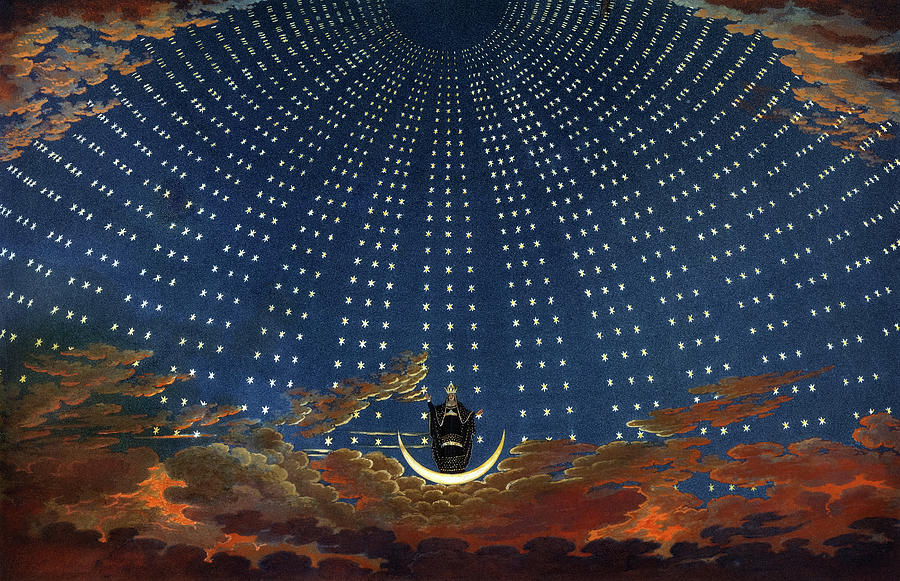
[above: 1847-1849 print of Karl Friedrich Schinkel’s design for the Queen of the Night in Act I, Berlin 1816]
Teaser
Mozart’s enchanting final opera. His most popular stage work.
A timeless moral tale in a world of clashing cultures.
Trials of courage and love. A journey that encounters serpents and magic interventions.
The dark realm of the vocally virtuosic Queen of the Night struggles against
the judgement and reason of Sarastro, high priest of Isis and Osiris
In between, a separated couple cope with trials and rituals,
and Papageno, a humble birdcatcher, searches for a wife.
— Irish National Opera, 2023

Buy a print from their shop!


Themes
- How much time you got? This one’s got it all, baby!
- This is the oldest opera we’ve studied together! It came out during George Washington’s first term as president. The French Revolution was in full swing. Kings were getting dethroned. In Austria, Mozart’s patron Emperor Joseph II had just abolished serfdom and promoted secularization and religious tolerance, then abruptly died 18 months before this show opened.
- Mozart himself died a few months after the premiere! So this is his last opera, and almost his last work.
- Is it possible to make a crowd-pleasing spectacle that also works as a serious philosophical allegory that educates the masses about the principles of Freemasonry?
- Maybe!
- Also they may have changed their minds halfway through the show and taken the plot in a completely different direction?
- Mommy issues
- Daddy issues
- Enlightenment via personal growth
- World peace via marital love & music
- “Steadfastness, patience, discretion”
- “Virtue, beauty, wisdom”
- The importance of joining cults
- Fraternity hazing rituals
- Generational trauma
- Generational inheritance
- Day/night, sun/stars, light/dark
- More problematically, male/female and white/black
- While also containing some of the greatest music in opera history, and some brilliant examples of theatrical writing that still work 232 years later
Setting

Emanuel Schikaneder worked with Mozart to create The Magic Flute for Schikaneder’s own theater, Vienna’s Freihaus-Theater auf der Wieden, which put on entertainments with spectacular stage machinery. In contrast to the Italian-language operas commissioned by the aristocracy, this German-language “people’s theater” combined music and spoken dialogue (a hybrid format called Singspiel, literally “sing-play”), and it catered to a trend for magic shows, fairy tales, and Orientalist fantasies. So, for example, the script calls for our tenor Tamino to wear “a splendid Japanese hunting garment.” But no realistic setting is intended.
To quote a blog post by Opera Grand Rapids, “the opera is set in two polar opposite kingdoms: The Kingdom of Night, symbolized by the moon and the color silver, and ruled by the Queen of the Night… and the Kingdom of the Temple of Wisdom, symbolized by the sun and the color gold, and led by the High Priest Sarastro.”
The article goes on to speculate that the Queen of the Night represents Austrian empress Maria Theresa, who had suppressed Freemasonry and died in 1780, ten years before this opera, while the high priest Sarastro represents Ignaz von Born, the head of the Vienna masonic lodge where Mozart and Schikaneder were inducted. Von Born had also written an influential 1784 essay comparing the religious practices of ancient Egypt to modern-day Freemasonry. So you’ll see a lot of gestures toward Egyptian culture in the text, and sometimes in the visuals as well.
Are these two kingdoms reconciled in the end? Or does one triumph over the other? Or both?
Characters

- Tamino (tenor) — a prince, wearing Japanese hunting attire
- Pamina (soprano) —a princess, daughter of the Queen of the Night
- Papageno (baritone) — a birdcatcher in a feathered coat [Papagei is German for “parrot”]
- Königin der Nacht / Queen of the Night (coloratura soprano) — mother to Pamina
- Sarastro (bass) — high priest of Isis and Osiris, wearing a sun symbol on his chest.
- Monostatos (baritone or tenor) — chief slave of the temple
- Speaker of the temple (bass-baritone)
- Three Ladies (sopranos, mezzo-soprano) — attendants to the Queen
- Three Boys (treble, alto, mezzo-soprano) — magical spirit guides
- An old woman / Papagena (soprano)
- Three priests (tenor, basses)
- Two armored men (tenor, bass)
- Three slaves (tenors, bass)
- Various priests, priestesses, slaves, populace, animals.
Libretto
Note: For this show, our situation is a bit more complicated than usual, because Die Zauberflöte was written as a Singspiel — with a combination of sung text and spoken dialogue. So you have more choices to make, whether to consult versions with or without the spoken text. If you have time, I’d encourage you to read the complete libretto, but don’t feel obligated to listen to people speaking German to each other for several minutes at a stretch.
So, you can download and read the full libretto in two different versions:
- German/English PDF libretto associated with the 1964 Klemperer/Warner recording. This PDF contains all sung text. The spoken dialogues are condensed into brief italicized summaries, like stage directions.
- German/English PDF libretto associated with the 1992 Östman/Decca recording. This PDF contains all sung AND spoken text. The spoken dialogues are printed in full, but in a lighter font weight.
Audio Recordings
Die Zauberflöte is perhaps the most popular opera in the world! [Operabase lists three other works above it if you count by number of different stagings (La Traviata, Carmen, and La Bohème), but if you count by performances, Zauberflöte beats them all.]
It’s staged constantly, and there are many professional recordings. For our purposes, I’m selecting three:
Highlights

Sometimes you don’t want to listen to an entire opera but just get familiar with the best parts. In that case, try the “Highlights” edition of the 1989 Philips recording conducted by Neville Marriner:
- Length: 1 hr 9 min
- Starring Kiri Te Kanawa (Pamina), Cheryl Studer (Queen of the Night), Francisco Araiza (Tamino), Samuel Ramey (Sarastro), Olaf Bär (Papageno), Eva Lind (Papagena), and José van Dam (Speaker)
- Stream the audio: amazon | apple | idagio | spotify | tidal | youtube.
- The tracks selected for this disc are highlighted in green in the track-by-track breakdowns below.
Whole Show – Music Only

For the best purely musical experience, I recommend the 1964 recording conducted by Otto Klemperer.
- Length: 2 hr 13 min
- Starring Gundula Janowitz (Pamina), Nicolai Gedda (Tamino), Lucia Popp (Queen of the Night), Walter Berry (Papageno), and Gottlob Frick (Sarastro)… plus Elisabeth Schwarzkopf and Christa Ludwig as two of the ladies! Incredible cast.
- Stream the audio: amazon | apple | idagio | spotify | tidal | youtube.
- The track-by-track breakdowns below use the numbering from this recording, and the associated libretto is this PDF file.
Whole show — music and dialogue

To get the complete audio experience, try the 1992 recording conducted by Arnold Östman.
- Length: 2 hr 35 min
- Starring Kurt Streit (Tamino), Barbara Bonney (Pamina), Sumi Jo (Queen of the Night), Gilles Cachemaille (Papageno), and Kristinn Sigmundsson (Sarastro)
- Stream the audio: amazon | apple | idagio | spotify | youtube.
Track-by-track Breakdown
Note that clicking any track title will take you directly to that audio file on YouTube!
1) Overture
- Have you heard this piece before? I wasn’t really familiar with it (compared to, say, the queen’s revenge aria “Der Hölle Rache”), but after a few listens it does feel pretty iconic.
- The opening fanfare is mentioned in every analysis of this opera — not only does it set a lofty grandiose tone to introduce a grand show about Big Ideas and Myths, but the bummmm [pause] bum bummmmm [pause] bum bummmmm [pause] is intepreted as a Masonic invocation of the magic number 3, and perhaps a special Masonic knock on the door of our minds.
- After a bit more grandiosity, we’re off the races (1:19) with the bouncy little violins that feel so characteristically Mozart, chasing each other playfully around the orchestra. “Don’t worry,” they say, “this won’t be a dreary chore. We’re going to have plenty of fun along the way.”
- What seems like a perfectly satisfying ending (3:28) is actually only the first half of the overture! The opera has a two-act structure with an intermission, so the overture does too. At this midpoint, the grandiose horns reappear with another triple knock on the door, this time not changing chords but just building a single chord fuller and fuller.
- Now (3:57) we’re back to the races, with the dance perhaps taking on a slightly darker tone. Maybe this quest isn’t going to be quite as easy as we might have thought?
- But of course it’s all going to work out in the end. Done right, the overture’s conclusion (6:34) should have us bouncing in our seats, ready for adventure.
Act One
Scene 1: A rough, rocky landscape
2) Zu Hilfe! Zu Hilfe! (Tamino · 3 Ladies)
A young prince, Tamino, runs in terror from a huge snake-monster. He eventually faints from fear and exhaustion. Luckily for him, three powerful Ladies enter and kill the serpent. Before they report back to their queen, the Ladies spend a while admiring the handsome unconscious prince and competing with each other over him.

- Just like Richard Wagner’s Ring cycle, The Magic Flute requires a giant dragon but only uses it for a few minutes. What a pity! But this opening stunt functions like a James Bond opening sequence, kicking off the adventure with a shot of adrenaline. Pay attention to how a particular director stages it: is this dragon a huge puppet, a digital projection, a group of dancers where each one represents a tooth, or a guy wearing a T-shirt with a dragon on it? The answer should help the audience calibrate our expectations for what kinds of spectacles we’ll get in the hours ahead.
- In the next century, Wagner also opened his sprawling mythological epic with a trio of flirtatious ladies… but unlike his Rheinmaidens, these girls are actually funny. Their jealous argument over the cute boy is timeless comedy, enhanced by the playful music and the way their lines interweave and interrupt each other. Ultimately they admit that none of them can be trusted alone with him.
- This opening also sets the tone for Tamino and his adventure: no particular motivation for who this guy is, why he’s here, why a dragon is chasing him, etc. Over the course of the show, will we see him make decisions and take actions? Or is he just a guy that things happen to?
[Tamino wakes up, confused but happy that the serpent is dead. Hearing the sound of panpipes approaching from a distance, he hides.]

3) Der Vogelfänger bin ich ja (Papageno)
A strange-looking man enters: Papageno the birdcatcher. He wears a coat made of feathers, plays the panpipes, and carries a large cage for his birds. He introduces himself with a jolly number about his carefree life among the birds, although he dreams about catching girls too.
- The baritone is the middle voice type for men. In contrast to the heroic/vainglorious tenor and the paternal/villainous bass, the baritone often represents a “regular guy,” or one who has the potential to go in either direction. That suits Papageno perfectly — despite his ridiculous feathery appearance, he is the relatable easygoing guy who lets the audience relax and makes Tamino look noble by comparison. Librettist and producer Schikaneder, a crowd-pleasing comedian, wrote the role for himself — described by one Tumblr user as “a self-insert furry character” — and Mozart wrote music to suit him: repetitive, charming, folksy, and not very difficult to sing.
- Like any good intro song, this not only introduces Papageno and his whole deal, but also reveals his motivation: behind his happy façade is a deep longing for female companionship.
[Tamino introduces himself as the son of a king who rules many lands. He learns that Papageno catches birds for “the star-blazing Queen” in exchange for food and drink, although he’s never met the Queen, only her Ladies. Papageno notices the dead serpent and freaks out, but in a moment of bravado he claims to be the one who killed it. Immediately, the Three Ladies return, scold him, and put a golden padlock on his lying mouth. They give Tamino a handheld portrait of the Queen’s daughter.]
4) Dies Bildnis ist bezaubernd schön (Tamino)
Tamino gazes at the portrait, smitten with the beautiful princess depicted.
- Tamino finally gets his first proper aria. It introduces him as a classic tenor protagonist: falling in love for the first time, instantly and thoroughly, and ready to make this girl his entire personality. It’s a classic yearning aria. Note that he’s so innocent, he doesn’t even know exactly what he would do with this girl if he found her.
- Several operas actually hinge on young lovers falling in love with somebody’s portrait, such as Wagner’s Der fliegende Holländer, Verdi’s Don Carlo(s), and Strauss’s Arabella. I can’t remember where I heard that “in Romanticism, the artistic image of a thing is more important than the thing itself,” but it’s an interesting angle here.
[The Ladies return to tell Tamino that the Queen has heard his love aria and he’s passed the audition. The girl in the picture is Pamina, and she’s been kidnapped by a powerful evil, but he can rescue her. Thunder and lightning signal the arrival of the Queen of the Night.]

5) O zitt’re nicht, mein lieber Sohn! (Queen of the Night)
The Queen laments her daughter’s kidnapping. She asks Tamino to go rescue Pamina and claim her hand in marriage as his reward.
- The Queen of the Night is maybe the most interesting character in the show, and there are lots of ways to play her. She’s both powerful and powerless at the same time. Is she basically a rich widow trying to find a nice boy for her daughter? Is she sincere or manipulative? Sympathetic or scary? Are there hints of erotic tension between her and Tamino?
- After the recitative-like opening “O zittre nicht, mein leiber Sohn,” the actual number is in two contrasting parts, a slow mournful first half (“Zum Leiden bin ich auserkoren”) and a fast motivating second half (“Du wirst sie zu befreien gehen”). This format would soon become established as a popular template for arias in the early 19th century, with a slow “cavatina” followed by a fast “cabaletta,” to show the performer’s dramatic & musical range.
- Speaking of range, the cabaletta here is the Queen’s first spectacular coloratura showcase (she gets another one in Act II). This one is quite brief, but with flurries of fast sixteenth-note runs, staccato arpeggios (short disconnected notes jumping up and down a chord), and an outrageous climax of a high F, it’s a showstopper.
- Mitchell Morris points out that the first three solo arias escalate, from a low-class folksy baritone, to a smooth princely tenor, to a supernaturally difficult soprano goddess, rising in complexity while they rise in pitch and social class.
[Tamino is dazzled but determined to carry out this quest.]
6) Hm! hm! hm! hm! (Papageno · Tamino · 3 Ladies)
While Tamino ponders his new quest, Papageno struggles with the padlock over his mouth. The three Ladies return to unlock him and everyone agrees that lying is wrong. The Ladies also give Tamino a golden flute to aid him in his adventure, and assign Papageno to go with him. Papageno is terrified of Sarastro and would rather stay home, but the Ladies give him a gift as well: a small box of silver bells. Finally, the Ladies instruct our heroes to keep an eye out for three wise young boys, who will help them reach their destination.
- It must be really hard to project to the back of an opera house with your mouth closed, but the “Hm! Hm! Hm!” padlock gag is so good. Mozart assigns the bassoon, perhaps the most goofy of all instruments, to accompany Papageno in this passage and make sure his melody comes across.
- These three ladies and two men can make a really charming quintet, especially if the performers have chemistry with each other. Sometimes I kinda wish they’d stick together!
- The lines about “If only all liars had their mouths locked, we would have love and brotherhood” are the first of several examples of this libretto blatantly pausing the show to tell us the moral of the story. In the 1975 film by Ingmar Bergman, he underlines these moments by having the cast sing directly into the camera while holding up the text on signs!
Scene 2: A grand chamber in the Egyptian style, in Sarastro’s palace
[Two chatty slaves celebrate because their cruel overseer, Monostatos, is going to get in trouble. His prisoner, Pamina, has escaped, and Lord Sarastro will be furious. Suddenly Monostatos enters and orders them to bring chains — he has successfully recaptured Pamina.]
- Monostatos is a real problem. He’s not the only slave, but he’s the only one described as a Moor or Black, and he’s set above these unnamed slaves as their brutish overseer. For 200 years he was played in blackface! Is it possible to do revisionist, restorative readings of this character? Or to sweep him under the rug? Frankly, I’m astonished that this show is as globally popular as it is today, given the challenges.
- Also, this isn’t explained yet, but Papageno and Tamino have gotten separated already, and the portrait of Pamina is now with Papageno.
7) Du feines Täubchen, nur herein! (Monostatos · Pamina · Papageno)
Monostatos has just recaptured Pamina. He chains her up and declares that her life is forfeit. She bravely says that she’s ready to die, and only regrets bringing grief to her mother. Outside the chamber, Papageno is thrilled to catch a glimpse of this beautiful girl through the window. He sneaks in, but Papageno and Monostatos both get spooked, mistaking each other for “the devil.” Both cry “Hoo!” and run away.
- This Scooby-Doo “a g-g-g-g-ghost!” moment usually gets a good laugh in the house. I guess the joke is supposed to be that Papageno looks scary because he’s a wild bird-man, and Monostatos looks scary because… he’s Black.
- This will not be not the last time that Monostatos’ looming threat (of violence, or sexual violence) evaporates in a lighthearted way thanks to the whimsical presence of Papageno.
[Papageno returns to Pamina’s chamber and now recognizes her as the Queen’s daughter. He tells her about Tamino, and she’s delighted that a prince is in love with her. Papageno grumbles that he has no “Papagena” to love.]
- Tamino isn’t here because apparently he decided to send Papageno ahead without him?? Because I guess he’s waiting for the three spiritual Boys to show up and guide him? This script could really use another draft.
8) Bei Männern, welche Liebe fühlen (Pamina · Papageno)
Pamina and Papageno moralize on the importance of love. Nothing is nobler than “Mann und Weib” — which can mean “man and woman” or “husband and wife.”

- Giving this duet to these two characters is an interesting choice. Neither one has actually met their future partner, but they’re trying to be optimistic. Do they have chemistry together, or is Papageno being a good wingman (no pun intended) for Tamino? Or does Papageno have “gay best friend” vibes?
Scene 3: A grove in front of 3 temples
9) Zum Ziele führt dich diese Bahn (3 Boys · Tamino · Speaker · voices)
The Three Boys lead Tamino to the Temple of Wisdom (center), the Temple of Nature (left) and Temple of Reason (right). They remind him to “Be steadfast, patient, and discreet,” then leave him to his quest. Tamino first tries to enter the Temple of Reason, but a voice orders him back. He tries the Temple of Nature, same thing. Finally at the middle door, he’s greeted by an old priest, the Speaker, who informs Tamino (to his horror) that Sarastro rules this temple. But he’s a bad guy, says Tamino. Who told you that, a woman?? You know how women are! The Speaker admits that Sarastro took custody of Pamina, but is forbidden to say more, “until friendship’s hand leads you into the eternal brotherhood.” He closes the door. Tamino laments: “O endless night! When will the light reach me?” In response, anonymous voices from within the Temple reply, “Soon… or never!” The voices also confirm that Pamina is still alive.
- The Klemperer recording lumps all this together into one 10-minute track! Maybe they think Tamino isn’t very interesting on his own. Maybe you agree.
- Klemperer also takes the coward’s route and casts adult women as the three Boys. I agree with Spike Hughes that “They are to be taken literally, for Mozart… conceived these parts in terms of the clear, ethereal tone-colour of boys’ voices.” As you can hear on the Östman recording, the effect is very charming, and makes a nice change of pace from the adults.
- Speaking of the adults… the door-knocking bit is fun, but the Speaker’s responses are tough to swallow. The part about revenge being a bad motivation is one thing, but:

- Here are some fun photos that give us an inkling of the various ways directors have interpreted the three boys.
10) Wie stark ist nicht dein Zauberton (Tamino)
Relieved that he still has a chance to save the princess, Tamino takes out his magic flute. Its beautiful tone brings wild animals to listen, but alas, no sign of Pamina. From a distance Tamino hears Papageno’s panpipes. Hoping Pamina is with him, he sets out in pursuit… although in the wrong direction.
- This “hero with a musical instrument charms forest animals… but it doesn’t summon the person he wants, but rather someone unexpected” scene has ancient mythic roots, and it’s also another trope that Wagner will borrow for his Ring cycle a century later.
- In the case of Tamino, he plays a major scale which happens to end in the same five notes as Papageno’s panflute, who then parrots it back. This callback really solidifies the bird-man’s role as the catchphrase-spouting sitcom character of the show. Tamino’s delighted response — ”Das ist Papagenos Ton!” — has become a catchphrase in our household.

11) Schnelle Füße, rascher Mut (Pamina · Papageno · Monostatos · slaves)
Pamina and Papageno enter, singing a charming little sneaking-song that’s almost as catchy as “Don’t Be Suspicious” from Parks & Rec. Monostatos, for all his problems, gets a terrific comedic moment here as he appears out of nowhere and sings the end of the song for them, ordering his slaves to seize the two. Papageno opens his magic chest of bells. The tinkling music is so delightful to Monostatos and his slaves that they dance merrily away.
- All this entering and exiting, wandering through the wilderness, is reminiscent of a Scooby-Doo chase scene, or Sondheim’s Into the Woods. Plus, not only are they playing “Marco Polo” trying to find each other with flute and panpipes, but we even get to hear and see both sides of the game.
- Monostatos again transforms from a threat to a buffoon, this time with backup dancers.
12) Könnte jeder brave Mann (Pamina · Papageno)
Pamina and Papageno moralize again: only the harmony of friendship can relieve pain.
- Mozart, of course, makes this brief duet an illustration of its text: an accessible but sweetly harmonized little hymn between friends.
- They do make a nice pair, eh? Spike Hughes calls them “two simple people — Papageno the child of nature, and Pamina as yet little more than a child.”

13) Es lebe Sarastro! (attendants · Papageno · Pamina · Sarastro)
Sarastro is coming, announced by brass and chorus. Papageno is terrified, as usual, but Pamina vows to tell him “the truth, even if it is a crime.” Sarastro finally arrives at the end of a long procession, riding a chariot pulled by six lions. Pamina kneels and admits she tried to escape his power, but only to get away from “the wicked Moor” who tried to molest her. Sarastro tells her to relax. He will not compel her to love, but neither will he release her back to her mother. The Queen is too proud, and they both (like all women) need the guidance of a man.
- After an hour of buildup, we finally meet the big man. How do we feel about him? He identifies as a wise and righteous ruler, the guide and protector that lesser beings need. Does the text support that? What about the music? And how does the director of any given production want us to feel?
- Is the implication that he wanted Pamina for himself, but is generously not forcing her, now that he can tell she is destined for Tamino?
14) Nun, stolzer Jüngling; nur hierher! (Monostatos · Pamina · Tamino · attendants · Sarastro)
Monostatos drags in Tamino. Boy and girl finally meet and excitedly embrace. Monostatos pulls them apart and proudly offers the captive to his master. Sarastro agrees to reward him — with 77 lashes to the feet! Such is the divine justice of Sarastro. He orders that Tamino and Pamina be taken to the Temple for purification. The chorus celebrates with a hymn to virtue and justice, which can make earth like heaven and mortals like gods.

ACT TWO
Scene 1: A grove of palms
15/2.1) March of the Priests (orchestra)
In a forest of silver and gold palm trees, Sarastro and the priests march solemnly to a set of 18 chairs capped with pyramids and gold-black horns.
[In a solemn ceremony, Sarastro proclaims that Prince Tamino wishes to remove the veil of night from himself and gaze upon the sanctuary of light. Following a ritual script, Sarastro confirms that this young man is virtuous, discreet, and charitable. He gives a little speech about “Vorurteil” (prejudice) being a threat to their cult. As a king’s son, Tamino will be a powerful asset of the temple. Once he’s a member, he will end the prejudice, punish the blasphemy of Pamina’s arrogant mother, and stop the trickery and superstition with which she’s trying to destroy them. But Sarastro, what if he fails? Then he will reach the afterlife before we do.]
The priests signal their acceptance of the candidature by a three-fold blast on their trumpets.
- Sarastro’s speech explaining the cult’s agenda is the libretto’s most explicit connection to the politics of Freemasonry in 18th-century Austria, contrasting the anti-masonic Empress Maria Theresa against her son, the Mason-friendly Emperor Joseph II.
- Also a very 1790s line: “He is a prince!” “More than that: he is a human being!”
16/2.2) O Isis und Osiris (Sarastro · 2 Priests)
Sarastro leads a prayer to Isis and Osiris, invoking their blessings on Tamino and Pamina.
- Spike Hughes points out that this “magnificent bass aria” is accompanied by low instrumentation as well, and says “This accompaniment is without doubt one of the most astonishing musical sounds ever created by man, unequalled in its warmth and sense of infinite expanse and depth.” I’ll have what he’s having.
Scene 2: A stormy night in a courtyard in front of the Temple
[Tamino and Papageno are led in with their heads hooded. Priests remove the hoods and leave them alone in the thunderstorm. The Speaker enters with a second priest to quiz them: are you willing to risk your life for the sake of friendship, love, and wisdom? Tamino bravely says yes. Papageno would prefer not to. But when the second priest mentions a beautiful and brave girl named Papagena who might be waiting for him, the birdman agrees. Now their “time of trial” begins: they may see their beloveds, but must not speak to them.]
- Thus begins the long initiation sequence that makes up the bulk of Act II. Some of the rules seem to be clear, but since it is a mystery cult, some of the details and motivations will never really be explained. Like a fraternity hazing, there’s an aspect of “just shut up and obey.”
- Thank God for Papageno, who undercuts the seriousness with some great lines freely admitting that he’s not very interested in discipline, suffering, or self-improvement.
17/2.3) Bewahret euch vor Weibertücken (2 Priests)
Before exiting, the two priests sing a duet about how men can be ruined by deceitful women.
- Hey Schikaneder? Buddy? Is everything, y’know… okay? Do you need to talk?
18/2.4) Wie? wie? wie? (3 Ladies · Papageno · Tamino · initiates)
The Three Ladies rise from a trap door and try to convince Tamino and Papageno to break their vows of silence and give up on the trial, saying that the priests are liars and doomed to Hell. They say the Queen is on her way to the temple. The lads are spooked (especially Papageno), but they more or less manage to resist.
Offstage priests raise the alarm — women have invaded the Temple! — and the Ladies are driven back through the trapdoor by thunder and lightning. Papageno faints.

- I really feel for Papageno in this scene, caught in the middle between the Ladies (who, remember, he has known for years, buying his birds and supplying him with food and only occasionally caging his mouth) on the one hand, and on the other hand his royal new friend Tamino, his vow of silence, and the promised possibility of a wife he’s never seen.
- Tamino, meanwhile, keeps himself focused and vents his frustration with his weak-willed friend by spouting a lot of classist and misogynist puffery.
- But like I said in track 6 above, I like this combination of voices, and I’m glad they get another quintet together. It’s great musical theater.
[One priest compliments Tamino on his manly self-control. A second priest scolds Papageno: get it together, man. Both initiates are once again hooded and led away.]
Scene 3: A pleasant garden, lit by moonlight
[Monostatos stumbles across Pamina sleeping. He winds up his nerve to try and kiss her.]
19/2.5) Alles fühlt der Liebe Freuden (Monostatos)
Monostatos tells himself that, despite his Black ugliness, he deserves love as much as anyone. He apologizes to the moon and asks it to hide for a moment so he can kiss this beautiful White girl.

- I can’t help hearing this as the precursor to a more famous baritone solo 25 years later, Figaro’s aria “Largo al factotum” from Rossini’s The Barber of Seville (1816). But while both are jaunty tunes with very similar openings, Monostatos’ is much harder to enjoy. Mozart and Schikaneder may be trying to sympathize with this Caliban-like character (even the downtrodden slave longs for love!) but it’s hard to shake the awful racial framework of the text here. I am black and therefore ugly, she is white and therefore beautiful.
- As a result, many productions straight-up change the text here (changing Schwarzer to Sklave, “because a slave is ugly”), or sing the original German but avoid any mention of race in the English subtitles.
- On the Every Voice podcast, gay Filipino tenor Rodell Rosel gave a sympathetic reading of Monostatos as a lonely outsider full of trauma and self-hatred, needing love.
- Let’s also remember that this is the same White girl who caused him to be whipped after she accused him of making a pass at her in Act I! Was she, as Terrance McKnight says, going “Karen mode” to scapegoat him? And yet he still longs for her.
[Just as Monostatos approaches Pamina, thunder and lightning: the Queen of the Night appears. She is devastated to learn that Tamino has renounced the world and applied to join the Temple. So much for her plan to rescue her daughter! Pamina asks her mother to help her escape the Temple, but the Queen is powerless — she explains that when her late husband was initiated, he surrendered his “all-consuming, sevenfold Sun-disc” to the Temple, and now it adorns Sarastro’s chest. Pamina says maybe the Temple guys aren’t so bad, which outrages her mother. Take this dagger, she commands, kill Sarastro, and bring me back that Sun-disc! Pamina is horrified.]
- This dialogue seems to me really pivotal. Now we understand more of the Queen’s backstory and motivations — she has watched this cult take her husband, take her daughter, and take her chosen son-in-law who was her best hope of getting her daughter back. All while dismissing her as a silly woman and saying it’s for her own good. I’m ready to stab somebody already! And if you need any more encouragement…

20/2.6) Der Hölle Rache kocht in meinem Herzen (Queen of the Night)
The Queen will brook no argument. Her heart blazes with vengeance, death, and destruction. Kill Sarastro, or you are no daughter of mine.
- This is it!!!!!!!!!!!!!! One of the top 5 most famous moments in opera. Mozart wrote it to show off the astounding vocal skills of his sister-in-law Josepha Weber, and 232 years later it’s still the ultimate symbol of soprano virtuosity. But it’s not just difficult to perform — it’s also immensely satisfying to listen to. Even when Mozart is representing pure rage, he can’t help filling the cloudy skies with bright light and color. Is that a concession to the Classical conventions of his era? Or is there a character note in there, that she perhaps gets so caught up in how good it feels to really let loose that she starts to enjoy herself?
- I’m also fascinated by the hinted backstory of Pamina’s dead father, the previous bearer of the sun-disc. Does that make Sarastro a usurper? i.e. there used to be a harmonious natural order where day and night were married and balanced, until this cult of solar “enlightenment” came along and disrupted it, erasing the night completely?? Was civilization a mistake???
[The Queen disappears. Pamina is overwhelmed by her situation. Monostatos sees an opportunity to play the hero, but she rejects him again. He furiously demands that she love him — or die! Sarastro appears and stops him. Monostatos exits, grumbling “If I can’t have the daughter, I’ll try my luck with the mother.”]
21/2.7) In diesen heil’gen Hallen (Sarastro)

Sarastro explains to Pamina that here in this temple, we don’t practice revenge. We forgive our enemies and return them to the righteous path with the power of friendship and love.
- Sarastro gets another solo aria, slow and majestic. He’s never in a hurry, never upset. He’s got the whole world in his hands. A good Sarastro performance should really radiate untouchable power and serenity, like the sun.
- Unless they want to show some cracks in his façade?
- This speech is a little hypocritical coming from the guy who had his slave-overseer whipped at the end of Act I.
Scene 4: A hall
[Tamino and Papageno are still enduring the trial of silence, although one of them is finding it a real challenge. When Papageno complains of thirst, a mysterious old woman brings him a drink. She calls him “my angel” and claims to be eighteen years old, but when he asks her name… you guessed it, thunder and lightning and she disappears.]
- Classic stage comedy, classic mythological riddles. Will we see this old woman again?

22/2.8) Seid uns zum zweiten Mal willkommen (3 Boys)
The Three Boys drift in on a flying machine. They come bearing gifts: Tamino’s magic flute and Papageno’s bell-chest, as well as a feast of food and drink. As the Boys fly away, they remind Tamino to have courage and Papageno to shut up.
[Tamino plays his flute. Papageno sits down to the feast. Pamina enters and tries to talk to her friends, but they maintain their vow of silence. Papageno’s self-control is assisted by having a mouth full of food. But they both turn their backs on her.]
23/2.9) Ach, ich fühl’s (Pamina)
Pamina is devastated to be treated so coldly by her beloved. Now that Tamino does not love her anymore, she can only find peace in death.

- Pamina finally gets a solo, and it’s a real knockout. Like her mother’s first solo, it’s a lament, but this one never switches to a fast cabaletta. She’s just heartbroken, and the people she thought were her friends are doing absolutely nothing to help. Sometimes opera is just constructing elaborate reasons to watch a pretty girl cry.
- I don’t know the baroque era well, but I always think of this as a throwback to that era. This sort of stately, royal, exquisitely tragic soprano aria, with an airy orchestral accompaniment, reminds me of “When I am laid in earth” from Purcell’s Dido and Aeneas (1689), “Lascia ch’io pianga” from Handel’s Rinaldo (1711), or “Ombra mai fu” from Handel’s Serse (1738).
[Pamina leaves, and a trombone triple fanfare summons our boys to their next trial. Actually, this happens three times, so it’s a triple triple fanfare.]
Scene 5: the vault of the pyramids
24/2.10) O Isis und Osiris, welche Wonne! (Priester)
Standing in a triangle and carrying pyramid-shaped lanterns, the priests praise Isis and Osiris, celebrating that Tamino will soon be initiated.
[A priest enters with Tamino. Sarastro compiments his progress so far, but there are two more trials ahead. Pamina is brought in and Sarastro commands the lovers to say their last goodbyes.]
25/2.11) Soll ich dich, Teurer (Pamina · Sarastro · Tamino)
Pamina has a foreboding of doom; Tamino is brave; Sarastro is inscrutable.
- In a score full of musical delights, this trio ended up as one of my surprise favorites. The call-and-response arrangement of these three voices is dramatically fascinating. Notice when they sing separately, or team up as two against one, or harmonize and interweave. Each configuration has a different emotional effect. That’s opera!!
Scene 6: A hall with many doors
[The Speaker informs Papageno that he has NOT qualified for initiation into the Temple. He’s fine with that: he’d settle for a glass of wine, which he receives. Now he’s totally content… right?]
26/2.12) Ein Mädchen oder Weibchen (Papageno)
Papageno takes out his chest of bells and sings merrily about his true desire. Without a wife, life is hell; but with one, life would be heavenly. If he’s really never going to find a girl, he might as well die.
[The mysterious old woman reappears. Papageno must marry her or be imprisoned forever. He reluctantly agrees — ”I’d rather have an old woman than none at all” — and instantly the old lady is revealed to be a young woman wearing exactly the same kind of feather-suit as he. As he moves to embrace“Papagena,” she is dragged away. Papageno is not worthy of her yet, says the Speaker.]

Scene 7: A garden
27/2.13) Bald prangt, den Morgen zu verkünden (3 Boys · Pamina)
The Three Boys fly back on stage, hailing the golden dawn. Pamina runs onstage, despairingly wielding the Queen’s dagger. She attempts suicide, but the Boys interrupt her, promising that Tamino really loves her. They cannot say more, but promise to lead her to him. All four moralize about the power of true love to overcome all mortal obstacles.
- Sigh. Sometimes opera is about watching a pretty girl try to kill herself. Many operas actually build the whole show around that moment, but here it’s fairly brief.
Scene 8: Two large mountains, one filled with fire and the other with a waterfall

28/2.14) Der, welcher wandert diese Straße (2 Armored Men · Tamino · Pamina)
Tamino is escorted to a harsh mountain by two guards in heavy armor. In contrast, he is barefoot and barely dressed. The guards intone ominously: “He who travels these laborious paths will be purified by fire, water, air and earth.” Tamino prepares for this final trial. Suddeny, Pamina calls from inside the mountain: “I must see you.” The guards open the gate and let her out so the two brave lovers can face this trial together.
- This reminds me of the opening to Mozart’s Requiem, left unfinished upon his death a few months after The Magic Flute’s premiere. In addition to the ominous mood, notice how the music moves at multiple speeds simultaneously, with the singers issuing syllables very slowly while the orchestra moves at 2x or 4x their speed.
- Apparently this melody comes from Martin Luther’s chorale of Psalm 12, “Ach Gott, vom Himmel sieh’ darein,” a text asking for God’s help while surrounded by enemies.
- But the arrival of Pamina’s voice instantly transforms the grim mood: now everything is possible.

29/2.15) Tamino mein! O welch ein Glück! (Pamina · Tamino · 2 Armored Men · 2 Priests · chorus)
The lovers head into the trial, hand in hand. Pamina tells him to play his flute, which her father carved from a thousand-year-old oak. While the flute leads the brass and timpani in a slow march, Tamino and Pamina pass through the trials of fire, water, air and earth. Finally they emerge, in front of the entrance to a glorious, brightly lit temple. The chorus celebrates their triumph: “the consecration of Isis is now yours.”

- Dead Daddy to the rescue! The tree-carving backstory lends support to my theory that this missing father represents an ancient nature-based harmony disrupted by Sarastro.
- The quartet of the two lovers and their armored escorts is just flat-out lovely. No notes.
- A storyline of “magical music saves the day” is always a challenge to live up to, because it requires music that truly sounds magical. KPop Demon Hunters, Purple Rain, A Goofy Movie, or That Thing You Do don’t work if the big song isn’t a certified banger. Fortunately, we’re dealing with Mozart here. Do you think he meets the moment?
- Bonus question for opera fans: how about Walther’s song in Die Meistersinger?
- The libretto implies that after entering the mountain doors, Tamino and Pamina are obscured from our view as they undergo these final elemental challenges — perhaps visible as shadows on a screen, or partially blocked by the set. As good Masons, Schikaneder and Mozart leave the exact details of these trials a mystery.
- As a result, there are countless ways to stage this scene. If I were directing a Magic Flute, I’d probably try to make this the key piece of stagecraft in the whole opera, and then build the rest of the show around it.
Scene 9: A garden

30/2.16) Papagena! (Papageno · 3 Boys)
Outside, Papageno is searching plaintively for Papagena, playing his panpipes and calling her name. Eventually he gives up and starts tying a noose around a tree. “If anybody wants to take pity on me, I won’t do it!” he announces, with dwindling hope. No answer. Counts to three… no answer. Just when he’s about to hang himself, the Three Boys come flying down and remind him about his magic bells. While he plays the bells, the boys fetch Papagena and present her to him.
- Once again Schikaneder writes himself an indulgent scene in which he can work the crowd. At this point we’re rooting for him so hard that we’re dying for this guy to finally get laid. When he plays his familiar little call-and-response meme melody and there’s no response, it’s both funny and heartbreaking, a little more each time.
- Actually, it seems almost risky to write a scene where the fan-favorite character begs for someone to answer him and lets the question hang in the air with the whole theater on the edge of their seats. I’d be worried about somebody in the audience shouting out “Don’t do it!” When the Boys do finally show up to stop him, it’s like Han Solo in the Millennium Falcon at the end of Star Wars.
- Also, just a side note to point out how many scene changes there are in this show! Many operas get away with using the same set for an entire act, but Schikaneder seems determined to show off the spectacular quick-change abilities of his theater. They even seem to happen more and more frequently as we rush toward the end. Quite cinematic.
31/2.17) Pa-pa-ge-na!… Pa-pa-ge-no! (Papageno · Papagena)
Papageno finally gets to meet his bride for real, and she’s everything he ever dreamed of. They both are nervous and stuttering at first (or perhaps she is gently mocking him), but swiftly embrace and indeed go straight into planning their children: little Papagenos and Papagenas.

- Papagena has quite a challenge: she gets about two minutes to justify two hours of buildup and prove that she is every bit as silly and lovable as our old friend Papageno.
- Fortunately, Mozart makes it easy by writing them the most charming duet I’ve ever heard in my damn life. They literally sound like chickens and do a little mating dance. Plus, it gradually accelerates, from slow and hesitant to a rip-roaring finale as they fantasize about popping out chick after chick after chick.
- I cannot stop listening to this number. It even works in 60-year-old black and white TV footage. But I think my favorite is Olaf Bär and Eva Lind on the 1989 Marriner recording. It’s the most chicken-like.
32/2.18) Nur stille! stille! stille! (Monostatos · Queen of the Night · 3 Ladies)

The Queen of the Night, her three Ladies, and their new ally Monostatos (who has switched sides) sneak into the garden. She has promised Pamina’s hand to Monostatos if he can help her exterminate the Frömmler (sanctimonious hypocrites) in the temple. BUT! Thunder and lightning! They are swept away by a waterfall and plunged into eternal night.
- Real cartoon villain hours here. “I’ll get you next time, Gadget!”
- If we were hoping for a substantial confrontation between the two sides here, unfortunately, this one is over in a flash. The Queen never even gets to confront Sarastro in person. I guess some people just can’t handle a strong woman.
Scene 10: “Immediately the whole theater turns into a sun.”

33/2.19) Die Strahlen der Sonne (Sarastro · chorus)
Sarastro presides over Tamino and Pamina (wearing priestly robes), his priests, and even the Three Boys (holding flowers). He proclaims the victory of light over darkness. The chorus rejoices: “Stärke” (power, fortitude) has triumphed! It crowns Beauty and Wisdom with an eternal crown.
- The good guys won… right?

Miscellaneous trivia, resources, notes, and further reading
- I find that podcasts can be a great way to get familiar with an opera, since you can hear musical examples interspersed with commentary.
- Probably the best one-stop for a brief overview of this show is LA Opera’s music director James Conlon doing 45 minutes “All About the Magic Flute” in Nov 2019.
- The Met Opera Guild podcast episode 9: “The Magic Flute and Masonic Symbolism” summarizes some of the scholarly debates about the Masonic themes used by Mozart and Schikaneder, while also playing the most beloved arias.
- The 2023 WQXR podcast Every Voice focuses on Blackness in opera, and starts with a miniseries about The Magic Flute and Monostatos. I enjoyed the original four 20-minute episodes but felt like they stretched a small amount of content over a lot of airtime, so now I’d recommend listening to the radio special that condenses the miniseries into 47 minutes. Also, you have the option to read the transcripts on their site:
- 2/16/23: “From Morehouse … to the opera house with Monostatos”
- 2/23/23: “Invisible Man”
- 3/2/23: “He Said, She Said”
- 3/9/23: “Recycling”
- 6/19/23: “Radio Special: The Magic Flute”
- The WQXR/Met Opera podcast Aria Code did an episode in 2019 called “Outrage Out of This World.” Host Rhiannon Giddens interviews four people about the Queen of the Night’s mega-famous rage aria “Der Hölle Rache” and how it was engraved into the golden record sent into space on the 1977 Voyager probes. Among the guests are science writer Timothy Ferris, who worked on the Voyager record project, and soprano Kathryn Lewek, who often plays the Queen at the Met and who closes the episode by singing it.
- LA Opera offers a lecture from October 2019, “Style and Status: Dr. Mitchell Morris on Music’s Social Roles in The Magic Flute” about 18th-century ideas of class and status and how those are encoded in the music.
- For more spectacular imagery, see this 2017 blog post on “The Magic Flute and Early Romanticism” from Seattle Opera’s dramaturg Jonathan Dean, or this 2024 production-design retrospective from San Francisco Opera.
- Full video recordings:
- If you’re a Medici.tv subscriber, they have four recordings:
- 2006, dir by Pierre Audi in Salzburg under Riccardo Muti, with a brightly colored primitivist aesthetic
- 2013, dir by Robert Carsen in Baden-Baden under Simon Rattle, set entirely in a park, with lots of projections
- 2019, dir by Barbe & Doucet at Glyndebourne under Ryan Wigglesworth, set in the kitchen of a fancy hotel and featuring the charismatic Björn Bürger as Papageno
- 2022, dir by Lydia Steier in Salzburg under Joana Mallwitz, with a World War I theme
- Here’s a short history of The Magic Flute at the Metropolitan Opera before 2023. Their “On Demand” streaming service has several video recordings:
- The John Cox production, with vivid designs by David Hockney, reached New York in 1991 (imported from Glyndebourne 1978) and was filmed that same year.
- Julie Taymor’s hyper-colorful puppet-infused production, which premiered in 2004, has been filmed in a full-length German version (3 hours) shot in 2017, as well as the abridged English version (2 hours) shot in 2006. The abridged English version continues to be a hot holiday ticket for tourists and families every December. It’s pretty spectacular!
- The latest production, from director Simon McBurney, was imported from English National Opera 2013 and reached the Met in 2023, when it was also filmed. As a tribute to Schikaneder’s original theater and its focus on stagecraft, this production involves a live foley artist performing sound effects and a live illustrator drawing projections, in addition to ropes and wires that make platforms (and signers) float in midair. Also, the orchestra pit is raised, making them part of the show.
- The Royal Opera House in London offers a 2017 recording of David McVicar’s production through their streaming service.
- Ingmar Bergman’s 1975 Swedish-language film version, Trollflöjten, is also great, with young actors who are lovely on camera, playful direction that blurs the boundaries between film and theater, and an overall sense of joy & whimsy.
- If you’re a Medici.tv subscriber, they have four recordings:
- In 2007, Mark Dornford-May from the company Dimpho di Kopane created a South African adaptation of The Magic Flute (Impempe Yomlingo) arranged for percussion ensemble, which has been performed in both English and Xhosa around the world.
- And if you’d like to pivot from the early part of the core operatic canon to the latter part, I must recommend Die Frau ohne Schatten (1919) by Richard Strauss and Hugo von Hoffmannsthal, who deliberately concieved their show as a modern-day heir to The Magic Flute. It has a similarly exotic fairytale setting, a supernatural king/queen dispute mirrored by an earthly man/woman relationship, a set of mysterious symbolic purification rituals, a thorny pile of attitudes about gender, and an obsession with making babies.

Leave a Reply