
PORGY AND BESS
Music by George Gershwin
Words by DuBose Heyward and Ira Gershwin
Premiered September 30, 1935 at the Colonial Theatre, Boston
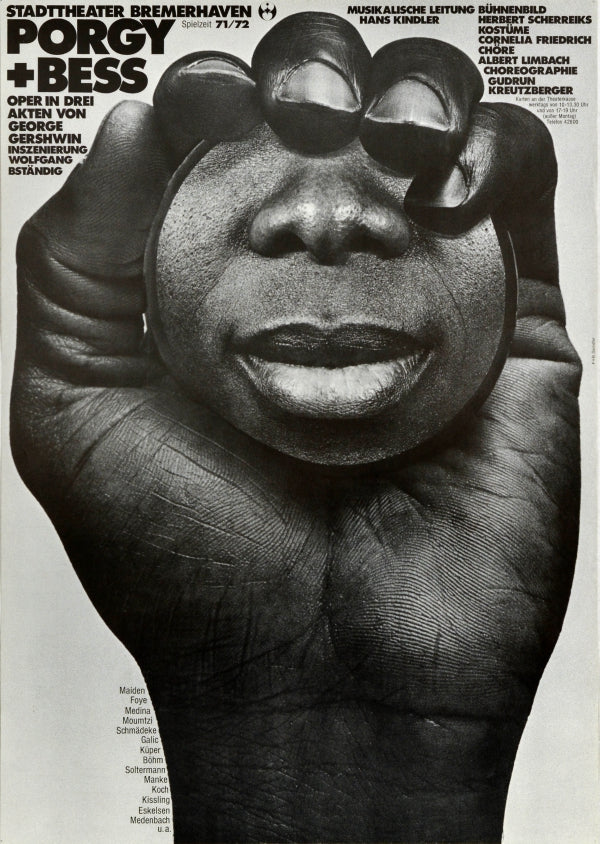
[above: poster by Frieder & Renate Grindler
for Wolfgang Bständig’s production at Stadttheater Bremerhaven, 1971–1972]
Teaser
For more than 85 years, Gershwin’s self-proclaimed “Folk Opera” Porgy and Bess has delighted audiences with its immediately recognizable hit tunes, flashy and energetic orchestration, and quintessential Americana feeling… The protagonists of this great American story, the easy-going and doting Porgy, and his loving but troubled soul mate Bess, take us on a complex and multilayered journey of adoration, deceit, heartbreak, and hope of redemption.
Lina González-Granados, 2020
Themes
- (Segregated) community life
- Underclass and shadow economy
- Contrasting models of masculinity and femininity
- Faith, hubris, superstition, and luck
- Poverty
- Disability and physical strength
- Resilience (both individual and collective)
- Ambition vs contentment
Creators and Creation

DuBose Heyward (1885-1940) grew up in Charleston, South Carolina, descended from an elite white family that was no longer wealthy, especially after his father died. His mother actually studied local Black dialects and folklore, and DuBose grew up interacting constantly with Black people and communities — although across a chasm of power differentials. He dropped out of high school and eventually pursued a writing career. In his late thirties, during a creative retreat at New Hampshire’s MacDowell Colony, he met Harvard-educated playwright Dorothy Kuhns, and they married in 1923, settling in Charleston. Two years later, his first novel was published, inspired by his observations of the local Gullah Geechee community and by a newspaper article about an attempted shooting by a disabled man named Samuel “Goat Sammy” Smalls. The resulting book1927, Porgy, was billed as a “beautiful and deeply moving novel of the Southern negro” and sold well, praised by white critics for its supposedly unique and authentic insight into Black life. Modern scholar Ellen Noonan writes that “Porgy combines melodrama and meticulously drawn details of character and locale to paint a picture that is deeply sympathetic to many of its characters yet also draws freely on a host of racial assumptions and stereotypes.” Skimming through it, my biggest surprise is that it’s full of 1920s purple prose, juxtaposed with very heavily rendered dialect for the Black characters — a bit like “what if H.P. Lovecraft, instead of being terrified of Black people, was paternalistically very fond of them?”
Dorothy had already had at least one script produced on Broadway, and she adapted her husband’s novel into a four-act play of the same name, which premiered in New York in 1927, with all Black roles played by Black actors. Noonan points out that this shift transformed Porgy from the product of a white novelist into a live presentation by Black performers, which made questions of authorship and authenticity considerably more complex. And it placed those performers in a bind — not only were they largely northern and middle-class actors and thus disconnected from the play’s setting, but the more convincingly they performed, the more they confirmed the show’s racist stereotypes. “For the many reviewers and audiences inclined to view it that way, the considerable skills of the actors cemented the Porgy story as a true representation of African American life.” Particularly during an era when the identity of “the New Negro” was hotly contested, at the peak of the Harlem Renaissance, this “respectability gap” (as Noonan calls it) was painful for many in the community who were deeply invested in Black excellence. In any case, the play was a major hit, running nearly a year on Broadway and then another year on tour, including nine weeks in London.
When George Gershwin first read the novel in 1926, he was already a successful songwriter and composer, having made a splash in the concert world with Rhapsody in Blue (1924), but was just beginning a very successful run of Broadway musicals with his brother Ira. He was immediately gripped by the idea of setting this very Black story to music — in 1922 he had composed an experimental one-act jazz opera set in Harlem, titled Blue Monday — but it would be a while before he could get to it.
Finally, in 1934 (after he’d become much more famous), Gershwin came to stay with Heyward on Folly Island, off the coast of Charleston, for five weeks of research and collaboration. They ended up with a three-act opera that closely followed the Heywards’ play, animated with a fascinating blend of late-Romantic/verismo operatic music, modernism, jazz, Broadway, folk, and southern Black spiritual music.
The original cast was highly trained, at a time when training was not easy to obtain: Todd Duncan (Porgy) chaired the music department at Howard, Anne Brown (Bess) and Ruby Elzy (Serena) both graduated from Juilliard, and Warren Coleman (Crown) studied at the New England Conservatory. Abbie Mitchell (Clara) had been on stage since she was fourteen, while John W. Bubbles (Sportin’ Life) was a wildly popular vaudevillian and the man who taught Fred Astaire to tap-dance.
NOTE: Although “George & Ira Gershwin” had become an iconic duo thanks to their dozen Broadway musicals between 1924–1933, it’s important to recognize that Porgy & Bess was primarily George Gershwin and DuBose Heyward, with Ira mostly relegated to polishing some of Heyward’s lyrics (although a couple are all Ira). Heyward was not a born songwriter, but his prose was quite poetic, and one could argue that the lack of Broadway “cleverness” is one of the elements that makes Porgy & Bess feel more like an opera than a musical.
Reception and Afterlife

For a serious dive into this topic, you really have to read Ellen Noonan’s 2012 book The Strange Career of Porgy and Bess: Race, Culture, and America’s Most Famous Opera.
In short, the original 1935 production was warmly received — during the “sustained applause” after the opening night in Boston, J. Rosamond Johnson (who played “Lawyer” Frazier and was himself a composer and arranger) whispered to Gershwin, “George, you’ve done it — you’re the Abraham Lincoln of Negro music.” Other Black composers were less enthusiastic. Duke Ellington felt that “it does not use the Negro musical idiom,” and Hall Johnson declared it “not a Negro opera by Gershwin, but Gershwin’s idea of what a Negro opera should be.” But the reviews were overall glowing! Unfortunately, ticket sales were modest. The show was expensive to stage, and the cast of 70 was gradually cut to 40 before it closed. Gershwin himself never made back his investment on the show before his death from a brain tumor in 1937 at the age of 38.
The 1950s became a pivotal decade for Porgy & Bess. A new production debuted in London in 1952, starring William Warfield as Porgy (fresh off his starmaking performance of “Ol’ Man River” in the 1951 film of Show Boat), Leontyne Price as Bess (fresh out of Juilliard, soon to become a superstar), and Cab Calloway as Sportin’ Life (a character who’d been partly inspired by Calloway himself). After landing on Broadway with a splash in 1953, the show toured for four solid years, including as Cold War international goodwill ambassadors for the U.S. State Department, which sent them across Europe, behind the Iron Curtain, and to South America to show off America’s cultural triumph. A young Truman Capote reported on the tour for New Yorker, producing a series of articles that became his first nonfiction book The Muses Are Heard.
At the same time, the jazz community was starting to absorb Porgy & Bess. In 1957, Ella Fitzgerald and Louis Armstrong recorded a stunning double LP interpreting almost all the songs from the show (with amazing arrangements by Russell Garcia), and in 1958 Miles Davis recorded his own Porgy and Bess LP (with arranger Gil Evans), taking not just a step in making this show “cool” but also a major showcase for Davis and Evans in their development of modal jazz, just months before the recording of Kind of Blue. Both the Fitzgerald/Armstrong album and the Davis album were released in spring 1959, to coincide with the anticipation for…
…the big-budget film adaptation, produced by Samuel Goldwyn, directed by Otto Preminger, and released in June 1959, with a starry cast including Sidney Poitier (Porgy), Dorothy Dandridge (Bess), and Sammy Davis Jr. (Sportin’ Life). Production was kind of a mess, with Poitier only participating under protest, and controversy muted the release such that it was pulled from several major cities and lost millions of dollars. Ira Gershwin reportedly hated the film, and has blocked its rerelease for decades, such that it’s now virtually impossible to obtain.
In the decades since, certain songs — “I Loves You, Porgy,” “Bess, You Is My Woman Now,” “It Ain’t Necessarily So,” and especially “Summertime” — have become international, intergenerational icons, while their source show remains a little bit uncomfortable. Is it a loving tribute to a real community in a particular time and place? An offensive fantasy of a subhuman underclass? A work of musical genius? A messy hodgepodge of voyeuristic musical dilettantism? A glorious portrait of human passions in the thrilling tradition of European opera? A bold, patriotic hybrid that could only happen in the cultural melting pot of America? The original Hamilton (complimentary)? The original Hamilton (derogatory)?
As with most things that are cringe or problematic, I tend to think the show’s biggest problems come from the weight placed upon it. If Gershwin hadn’t died so young and had lived to write more, if great Black composers had written successful operas, if Hollywood and academic music and cultural trends hadn’t drained the blood from classical composition around WWII… then we’d be having a very different conversation. But the scarcity of comparable works means that Porgy & Bess is often asked to carry the load of being THE African American opera, or even THE American opera, and under that weight, its limitations and idiosyncrasies become difficult to bear.

Characters

Dorothy Dandridge (Bess), and more in the 1959 film adaptation.
- Porgy, a disabled beggar (bass-baritone)
- He sometimes travels by a cart drawn by a goat. This is a bigger deal in the novel than the opera, but goat or not, Porgy doesn’t have the use of his legs, and his enemies never let him forget it for a moment.
- Speaking of the novel, this is how he’s first described:
- Once a child saw Porgy, and said suddenly, “What is he waiting for?” That expressed him better than anything else. He was waiting, waiting with the concentrating intensity of a burning glass.
- Later, when he gets together with Bess, he seems to turn a corner and come into his own… which raises the question of how far he would go to keep from losing her.
- As a beggar who travels into the city to solicit money, Porgy also is portrayed (especially in the novel) as having a knack for talking to white people
- Bess, a beautiful young woman, perhaps a sex worker (soprano)
- The Graves Foundation exhibit calls her “The Complex Protagonist.”
- How much agency does she have? What is her standing in the community? Why does everyone talk like she’s a piece of property held by one man or another?
- If Bess begins as a Jezebel stereotype, how does she evolve over the course of the show? Her relationships with Porgy and Crown change — what about with the rest of the community, especially the other women?
- Crown, a tough stevedore, strong from hauling heavy bales of cotton all day (baritone)
- The physical villain of the piece, Crown can easily slide into stereotypes of a huge, animalistic, sexually aggressive killer. Indeed, as the story unfolds, he might display superhuman levels of strength and endurance. Can the show find a way to give him dimension?
- Sportin’ Life, a charming drug dealer (tenor)
- The other villain, whose threat is not physical but spiritual. He could represent Satan, atheism, materialism, queerness, or all of the above. He definitely represents drugs!
- Robbins, a fisherman (tenor)
- Serves mainly to have bad luck and die early, alas.
- Serena, Robbins’ devoted wife (soprano)
- Graves: “The Moral Voice.” Serena is the most consistently religious of the characters, and her transformation into a widow charges her with even more spiritual weight.
- Jake, a fisherman (baritone)
- Young and ambitious, Jake has big dreams for his baby son.
- Clara, Jake’s wife (soprano)
- Graves: “The Embodiment of Hope.” She and Jake are just beginning their family’s story.
- Maria, keeper of the cook-shop (contralto)
- Graves: “The Pragmatic Matriarch.” Could be played for comic relief, or presented as a dignified authority figure at the center of the community.
- Peter, the honey man (tenor)
- Lily, Peter’s wife (soprano)
- Frazier, a predatory black “lawyer” (baritone)
- Mingo, one of the guys (tenor)
- Annie, one of the girls (mezzo)
- an undertaker (baritone)
- Jim, a stevedore who hauls cotton (baritone)
- Nelson, a fisherman (tenor)
- the strawberry woman (mezzo)
- the crab man (tenor)
- Scipio, a small boy (treble)
- Mr. Archdale, a white lawyer (spoken)
- a white detective, policeman, and coroner (spoken)
- Various residents of Catfish Row, fishermen, children, stevedores, etc (chorus)
Setting

Catfish Row, a crowded Black tenement community converted from a former mansion near the waterfront of Charleston, South Carolina, in the early 1900s. This setting is inspired by a real block in Charleston named Cabbage Row, about which you can read more via the College of Charleston. Today one of the occupants is an antique map store! The nearby (real) vacation destination of Kiawah Island, has likewise been transformed into Kittiwah Island, which features in Act II.
Recommended Audio Recordings
- You can download and read the full libretto here:
- Complete English PDF libretto associated with the 1975 Maazel/Decca recording.

There are several acclaimed recordings of Porgy and Bess, but the one with the most convenient PDF libretto is also the first completely unabridged version and the first one to win a Grammy Award — the 1975 recording conducted by Lorin Maazel in Cleveland, with a young cast led by Willard White (Porgy) and Leona Mitchell (Bess), still in print from Decca Records.
Sir Willard is one of my favorite bass-baritones, and as reviewer Mike Parr says, the producers “delivered a rip-roaring theatrical presentation of the opera… Hearing a full assortment of rolling dice, boat whistles, slamming and locking of doors etc., adds to the vivid theatricality of the listening experience.” Bonus trivia: Sportin’ Life is sung by François Clemmons, who played the police officer on Mister Rogers’ Neighborhood for 24 years!
The track-by-track breakdowns below use the numbering from this recording, split across 3 discs.
Run time: 3 hr 1 min
Stream the audio from your preferred service:
apple | amazon | idagio | spotify | tidal | youtube
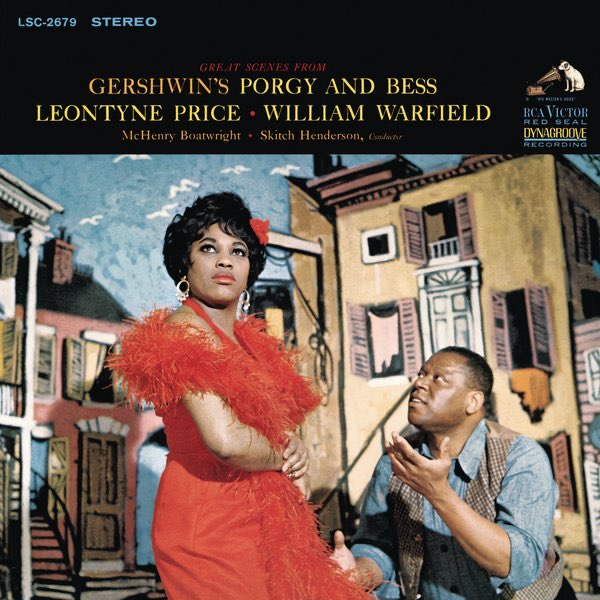
For a one-disc compilation of highlights, I recommend this album on RCA Victor, usually titled “Great Scenes from Gershwin’s Porgy and Bess” and recorded in 1963, featuring the cast that had brought this opera to international fame in the 1950s.
Conducted by Skitch Henderson
Starring William Warfield (Porgy) and Leontyne Price (Bess)
Run time: 48 min
Stream the audio: apple | amazon | idagio | spotify | tidal | youtube
I have marked the tracks featured on this disc with green highlighter below.
Uniquely in opera, Gershwin’s work on Porgy & Bess also ended up inspiring a slew of recordings from jazz artists in the late 1950s. Two of these albums in particular are not merely interesting novelties for fans of the opera — they are major landmarks in the history of jazz.
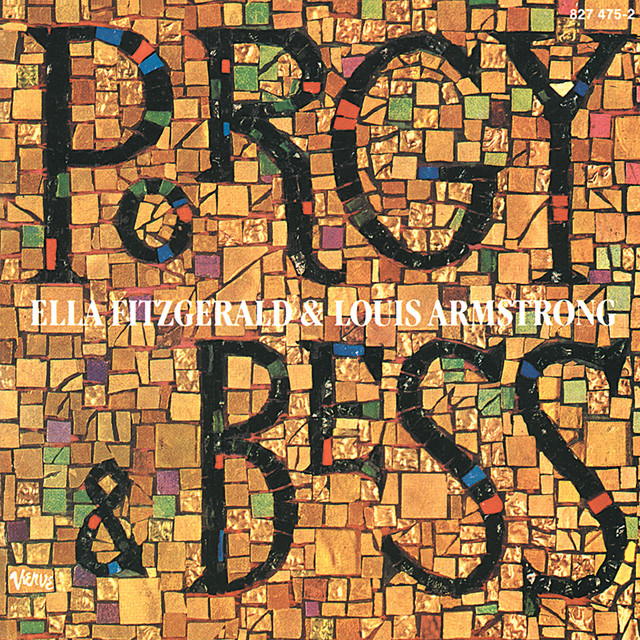
In 1957, iconic collaborators Ella Fitzgerald and Louis Armstrong reunited to record a double album of orchestral-vocal-jazz renditions of almost every tune from Porgy and Bess, released in April 1959 right before the movie adaptation.
Arranged and conducted by Russell Garcia
Featuring Ella Fitzgerald (vocals) and Louis Armstrong (vocals, trumpet)
“One of the great vocal albums of the era, and arguably of all time.” — Apple Music
Stream the audio: apple | amazon | spotify | tidal | youtube
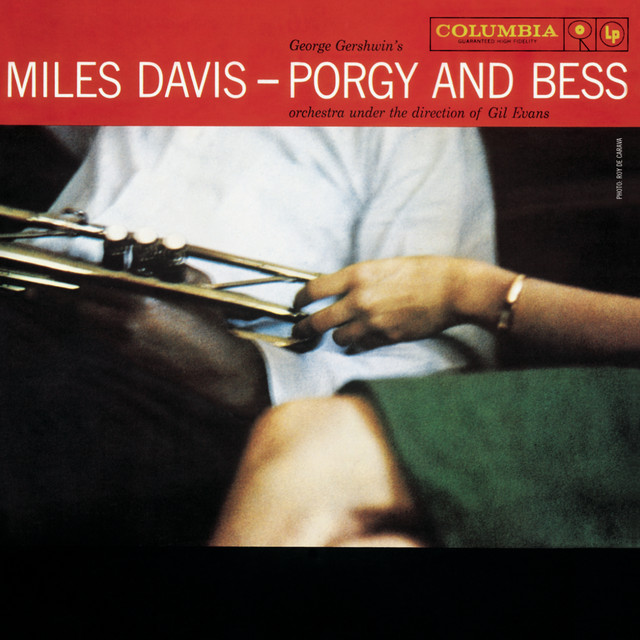
Meanwhile, in 1958, the great Miles Davis (whose girlfriend Frances Taylor was a dancer in the off-Broadway production at the time) recorded his own Porgy and Bess album, likewise released in spring 1959 in the run-up to the movie. With frequent collaborator Gil Evans, he combined tight big-band arrangements with spacious “modal jazz” mood pieces that paved the way for Kind of Blue the following year.
Arranged and conducted by Gil Evans
Featuring Miles Davis (trumpet, flugelhorn), Cannonball Adderley (alto sax), Paul Chambers (bass), Philly Joe Jones and Jimmy Cobb (drums)
“No observation or collection of American jazz can be deemed complete without this recording.” — Lindsay Planer, Allmusic
Stream the audio: apple | amazon | spotify | tidal | youtube
Complete Libretto
You can download and read along with the full Porgy and Bess libretto, courtesy of Decca Records, using the track numbers from their 1975 recording conducted by Lorin Maazel (the first recording linked above).
Scene by Scene
ACT ONE

Act I Scene 1: Catfish Row street, evening
1.1) Introduction – Jazzbo Brown Blues – 5:20
After a brief overture, we hear Jazzbo Brown at his piano playing a “low-down blues.” Several couples dance in a slow and hypnotic rhythm. The chorus chants and sings wordlessly, building to a frantic orchestral climax.
- Upon first listening, I was stunned by the energy of this opening (I really should learn to play that xylophone lick). Then I was baffled by the directionless “waves” of what comes after. This is meant to be a dance? It sounds more like a bad drug trip. And just when the repetition becomes truly unbearable, the fever breaks, and a sweet clarinet descends from heaven to usher in…
1.2) Summertime – 8:45
Young mother Clara sings a lullaby to her baby son.
- One of the most famous songs ever written, surely? It’s a hell of a number for a composer to throw down as the first aria in his first opera. And this won’t be the only time we hear it.
- The first verse reassures the baby that all is well, while the second verse (accompanied by a female chorus moaning “oooh”) looks ahead to the time when the child will spread his wings.
- In the Aria Code podcast, Naomi André suggests that the orchestra’s ambiguous 7th chords lend a sense of eerie uncertainty which contrasts with Clara’s soothing words. Maybe life isn’t going to work out as smoothly as she hopes.
Some men (including Sportin’ Life, Mingo, and Jake) are rolling dice in a craps game. A fisherman, Robbins, joins the game, over the protestations of his wife, Serena. Another man, Jim, is tired of hauling bales of cotton and throws down his cotton-hook; some children scramble for it. As Clara sings a reprise of “Summertime,” her husband Jake takes over caring for the baby.
1.3) A Woman Is a Sometime Thing – 2:01
Jake and the men sing to the baby not to trust women or take them too seriously, despite their fundamental role in human life. But then the baby cries again.
- What’s the effect of placing this song after “Summertime”? We’ve now seen this baby hear from both its mother and father in turn. What lessons are they imparting, to him and to us?
- In 2004, Sesame Street parodied this song as Kevin Clash’s Hoots the Owl (inspired by Louis Armstrong) informed Cookie Monster that “A Cookie Is a Sometime Food.” This sparked a minor controversy when media incorrectly reported that Cookie Monster was learning to eat healthy and giving up his favorite food of cookies — an early example of the Internet culture war grievance machine in action.
1.4) Here come de honey man … Here’s the ol’ crap shark – 3:27
Peter, the elderly honey man, arrives, greeted by his wife Lily. Porgy enters in his goat cart, flush with the money he acquired begging from Buckras (white people) and ready to gamble. Folks tease him about having a crush on Bess, the “liquor-guzzlin’ slut” who belongs to the volatile Crown. Porgy complains “Between the Gawd-fearin’ ladies and the Gawd-damnin’ men, that gal ain’t got a chance.”
1.5) They pass by singin’…Here comes Big Boy!…Don’t you ever let a woman grieve you – 8:45
Porgy says he has no expectation of love, as his disability is proof that God intended him to be alone. Crown strides on with Bess on his arm, and the game resumes, while Crown grows more drunk and belligerent (especially after Sportin’ Life gives him some “happy dust”). He repeatedly has Bess pay for him. Peter the honeyman warns them to take it easy, but Crown silences him with a threat.
1.6) O, little stars…Touch that money an’ meet yo’ Gawd! – 3:57
Porgy and Robbins take their turns shooting dice. Crown accuses Robbins of cheating and they fight. Crown stabs Robbins to death with a cotton hook. Robbins’ wife Serena screams.
1.7) Wake up an’ hit it out!…That you, Sportin’ Life? – 4:27
The whole crowd disperses in a panic. Crown and Bess agree that he must get out of town. What about her? “Some man always willin’ to take care of Bess,” she says. Left alone, she gets a hit of “happy dust” from Sportin’ Life to take the edge off. SL offers to let her work for him in New York, but she says “I ain’t come to that yet.” As Bess wanders the neighborhood looking for shelter and police whistles fill the air, everyone refuses to help, except Porgy, who opens his door to her.

Act I Scene 2: Serena’s Room
1.8) Gone, Gone, Gone – 3:40
Robbins’ body is laid out on the bed, with a saucer on his chest. Mourners gather to drop donations into the saucer for his burial. They sing an impassioned spiritual lamenting his death. Porgy and Bess enter. Serena initially refuses to let Bess donate money from the man who killed her husband, but when Bess explains that her money comes from Porgy now, she accepts.
- Gershwin’s music for this solemn funeral service reminds me a bit of Puccini’s church service in Act I of Tosca, but with a definitively Southern Black character. Still, the longer it goes on (and as Porgy and Bess arrive to disturb the situation), the more he pushes the chords into more and more intense territory.
1.9) Overflow, Overflow … Gawd got plenty of money for de saucer – 2:53
The mourners sing a new spiritual of hope that God will provide for the family’s needs. Porgy ends up sounding like a preacher as he leads the song.
- What is Porgy’s role in the community? Is he respected, beloved, looked down upon, tolerated?
1.1) Um! A saucer-burial setup, I see – 3:36
An unsympathetic white detective enters with two policemen. He arbitrarily accuses Peter the honeyman of the murder, but Peter names Crown as the culprit. When questioned, Porgy denies knowing anything. The police take Peter to jail “as a material witness” until they catch Crown, and remind Serena that the body must be buried tomorrow or else given over to medical students. As they exit, Porgy laments the injustice of the situation.
1.11) My Man’s Gone Now – 6:35
In a solo, Serena mourns her husband Robbins.
- This aria is pretty spectacular: the poetry, the soprano’s melodies, the orchestra’s mournful jazzy swooning, the haunting backup choir, and some spectacularly modern “special effects” from both Serena and choir at the climax.
The saucer has gathered $15, less than the undertaker’s costs of $25, but he takes pity and agrees to bury Robbins.
1.12) Headin’ for the Promis’ Lan’ – 4:31
Bess jumps up to lead the choir in another spiritual hymn of expectation.
- We may be surprised by Bess’s religiosity here, or by the crowd’s acceptance of it from her. Maybe it says a lot about how faith and participation work in this community. Certainly we’re a long way from the hierarchical European Catholicism of most operas!
- Or maybe the writers just needed a strong finish for Act One and wanted to give both title characters a brief opportunity to lead the choir before intermission?
ACT TWO
Act II Scene 1: On the waterfront
13/2.1) It Takes a Long Pull to Get There – 3:49
Jake and other fishermen are repairing their nets, preparing to go fishing. He leads them in a rowing song about persevering through obstacles to reach the promised land.
A picnic is coming up on Kittiwah Island. Jake’s wife Clara pleads with him not to go fishing — it’s storm season — but he persists, hoping to make enough money to send their baby boy to college.
14/2.2) I Got Plenty o’ Nuttin’ – 3:46
Porgy, at his window, bursts into a song of contentment. He doesn’t need material possessions, because the best things in life are free: “Got my gal, got my Lawd, got my song.”
- There’s considerable discussion of this song in the Aria Code podcast, including the role of the banjo in signifying rustic (and specifically Black!) simplicity.
- What Heyward (and possibly Ira Gershwin) pull off with the first two lines is surprisingly profound: what does it mean to have plenty of nothing, and for nothing to be plenty?
The neighbors notice how Porgy’s mood has improved since Bess came to live with him. Maria scolds Sportin’ Life for trying to sell his happy dust around her shop.
15/2.3) I hates yo’ struttin’ style…Mornin’, Lawyer…Dey’s a Buckra comin’ – 7:46
Maria threatens Sportin’ Life with a knife and a vicious song.
“Lawyer” Frazier approaches Porgy and Bess. He encourages them to legitimize their relationship by certifying her divorce from Crown, although they were never married. Frazier calls this inconvenient fact “a complication” which will raise the price of the certificate from $1 to $1.50: “It take expert to divorce woman what ain’t marry.” Porgy pays it.
A sympathetic white lawyer, Mr. Archdale, enters looking for Porgy. At first nobody trusts him, but when Serena vouches for Archdale as “folks,” he gets a warmer reception. Archdale announces that he will pay for old Peter to be released on bond, because Peter’s family used to belong to his family.
Archdale also tells Frazier to stop selling fake legal services.
16/2.4) Buzzard Song – 6:50
Suddenly, a huge buzzard flies low over the area, spooking the crowd. Porgy explains to Archdale that the bird is a terrible omen, and sings to the bird to keep away — trouble has no place here.
- The music cue after the Buzzard Song (at 3:25 in this recording) sounds startlingly modern to my ears, with the glockenspiel leading arpeggios that wouldn’t feel out of place in a movie.
The crowd disperses. Sportin’ Life slides up to Bess, asking if she is going to the picnic. She refuses his offer of happy dust. Porgy grabs Sportin’ Life and sends him packing. Jake and Clara pass through, dressed up for the picnic.
17/2.5) Bess, You Is My Woman Now – 4:42
Porgy and Bess are left alone to sing their love duet.
- This sinuous melody is justifiably famous. It mostly strikes me as a plush cloud of gorgeous late-Romantic schmaltz, tweaked with jazzy blue notes. As a songwriter first and composer second, Gershwin also isn’t shy about repeating his material with multiple verses — which also pays off for the opera composer who will need to draw upon this melody later as a leitmotif reminder of this relationship.
18/2.6) Oh, I Can’t Sit Down – 4:01
Everyone comes out to celebrate the picnic. Good feelings all around.
Maria insists that Bess come along to the party. She intends to stay with Porgy, but he encourages her to go. Left to himself, Porgy reprises “I Got Plenty o’ Nuttin’.”
- I guess it’s not an option for Porgy to get on the ferry to the island?
Act II Scene 2: Kittiwah Island

19/2.7) I Ain’t Got No Shame – 2:39
That evening, the picnic is in full swing and the crowd goes wild.
- Pounding drums yield to a fast-paced sort of oom-pah march, but the drums keep returning. Is this an attempt at exoticism (Lehman Engel’s synopsis calls this “dancing and singing à l’Africaine,” a weird turn of phrase in the otherwise respectful 1970s Decca booklet), a reflection of the party’s hedonism, or a signal of the storms ahead?
- I’m not sure it’s very convincing as party music… for any culture. Oddly enough this is something that I’ve noticed operas often struggle with! You’d think music-drama would be the ideal art form for capturing the feel of people dancing at a party, but it often comes off stilted.
20/2.8) It Ain’t Necessarily So – 9:32
The mephistophelean Sportin’ Life takes center stage with a charming and cynical song about not taking the Bible too seriously.
- If the party already felt disjointed, this song can feel even more odd, but at least it’s on theme with the sinful nature of the party, and it’s a timeless classic that’s been sung by everyone.
- This is one of the few lyrics in the show almost entirely by Ira Gershwin (and it has real “a writer wrote this” syndrome, for better or worse). In his book Lyrics on Several Occasions, Ira points out that each verse is basically a limerick. He started with the title first, as a placeholder of dummy syllables, but then decided to trust his instinct and built the rest of the song around that title.
- Wikipedia mentions that in the 2000s, musicologists Jack Gottlieb and Howard Pollack linked this melody to the traditional Jewish blessing “Bar’chu et adonai ham’vorach” recited before reading from the Torah! How appropriate for this song of Biblical exegesis.

- Ira’s book also reports that the song “became something like a resistance hymn in Nazi-occupied Denmark — ever since the evening when, after the grimly boastful routine broadcast of the German army’s usual victory communiqué, the secret Danish underground radio had cheerfully cut in with a significant ‘It Ain’t Necessarily So.’”
- He also gives a bonus “encore limerick” that isn’t in the usual score:
- ‘Way back in 5,000 B.C.
Ole Adam and Eve had to flee.
Sure, dey did dat deed in
De Garden of Eden—
But why chasterize you an’ me?
- ‘Way back in 5,000 B.C.
Serena interrupts the end of his song to holler “Shame on all you sinners!” The steamboat whistle blows and everyone prepares to return to the mainland. As Bess heads to the boat, Crown calls out to her. He has been hiding on the island since killing Robbins, and he plans to catch a ride on a riverboat to Savannah once cotton season comes. Crown laughs to learn that Bess is living with Porgy (and “livin’ decent”), insisting that she still belongs to him.
21/2.9) Oh! What You Want wid Bess? – 3:46
Bess protests that she’s getting old and Crown should move on to a younger girl — she belongs with Porgy, who needs her and would die without her. The boat is leaving, but Crown refuses to let her go.
- Engel observes how this “develops into a kind of grotesque duet.” But the real grotesquerie comes after they stop singing, when Bess realizes there is no escape and the orchestra voices her inner dread as the boat takes off without her.
Act II Scene 3: Catfish Row, weeks later
22/2.10) Honey, dat’s all de breakfast…Take yo’ han’s off me – 4:37
Early in the morning, Jake and his fellow fishermen prepare to head out to sea. From Porgy’s room, we hear Bess — she returned from the island a week ago, but is still sick and delirious, traumatized from some ordeal. Peter returns from jail and suggests Bess go to the “white folks hospital.” Serena offers to heal her with prayer instead.
23/2.11) Oh, Doctor Jesus – 2:22
Serena prays for Jesus to heal Bess.
24/2.12) Oh, dey’s so fresh … I’m talkin’ about devil crabs – 3:17
The street awakens with market activity. Each vendor begins their whooping sales call, starting with the Strawberry Woman, then Peter the Honey Man, then the Crab Man.
25/2.13) Porgy, Porgy, dat you there – 2:37
Bess calls out for Porgy: she has recovered. He fills her in on what she missed: she returned from Kittiwah Island “with eye like fireball” and wasn’t in her right mind. Porgy knows she met up with Crown and doesn’t blame her for it — if she wants to go back to him, she can.
26/2.14) I Loves You, Porgy – 3:26
Bess wants to stay with Porgy, but fears she only deserves Crown’s abuse: “It’s goin’ to be like dyin’… but when he calls, I know I have to go.” She struggles to hope that a better life, with Porgy, is possible. Porgy insists that the choice is hers: if she wants to stay, then she’ll stay.
- Note there’s a slight error in the Decca PDF libretto: track 14 should begin on page 24, halfway down the first column, with Bess’s line “I wants to stay here, but I ain’t worthy.”
- Here is one of the swooniest melodies in a score full of them — packed with yearning, grief, remorse, relief, hope, doubt… all the stuff that opera is made of.
- When Porgy asks “what if dere warn’t no Crown,” the music shifts to tense tremolo strings. That’s a hint that he’s not just asking her to consider a hypothetical.
- This one might be an Ira Gershwin lyric.
27/2.15) Why you been out on that wharf? – 2:36
Maria notices that Clara is watching the sea, filled with dread, listening for the hurricane bell. Suddenly it rings. Clara cries out for Jake and faints.
- Composers love to write storm music — a situation where no amount of orchestral sturm und drang can be too much! This might be the best one since Verdi?
Act II Scene 4: Serena’s room
28/3.1) Oh, Doctor Jesus, look down on me wit’ pity – 2:23
A group huddles indoors during a violent hurricane, murmuring various prayers to themselves.
- Engal says “This is a most original number in which six separate musical lines move freely against one another (there are no measure-bars) and against a sustained humming choral background.” It’s a powerful way of suggesting both togetherness and frightened isolation.
29/3.2) Oh, de Lawd shake de heavens…One of dese mornings – 4:02
The group’s prayers cohere into a more traditional spiritual chorus.
- Still, rising about the choir, there is some fun character work from Porgy, Clara, Serena, and Sportin’ Life, each voicing their perspectives on the situation and the relative value of prayer.
After a terrifying thunderclap, Clara clutches her baby and sings a brief reprise of “Summertime”. Porgy and Bess console themselves with the hope that Crown couldn’t survive on the island during a storm like this.
30/3.3) Oh Dere’s Somebody Knockin’ at de Do’ – 5:13
The choir murmur about a knock at the door — is it a metaphor for Death? Is someone literally pounding on the door? In all the noise it’s hard to tell. The group tries to hold the door closed, but suddenly Crown bursts in. He tries to claim Bess, who resists. Porgy tries to defend her, but Crown throws him to the floor. Serena urges Crown to respect God and respect the danger of the storm, but Crown points out “If Gawd want to kill me, He had plenty of chance ‘tween here an’ Kittiwah Island.” He and God have wrestled plenty, and now they have an understanding.
31/3.4) A Red-Headed Woman…Jake’s boat….Oh, Doctor Jesus – 5:38
Crown brags that no woman can make a fool of him, while the chorus prays for God to strike down this arrogant villain. Clara sees her husband Jake’s boat upside down in the river, screams, gives her baby to Bess, and rushes out into the storm. Bess calls out for a man to help Clara. Crown taunts Porgy for not fitting the bill, then “as the only man ‘round here” ventures out to get Clara, vowing to return to get Bess.
- He’s a supervillain full of hubris, but he can’t turn down an opportunity to prove his manliness. Was this an intentional play by Bess to get rid of him??
The remaining singers resume their “free” spiritual, “Oh, Doctor Jesus.”
ACT III

Act III Scene 1: Catfish Row, after the storm
32/3.5) Clara, Clara…Crown, Crown…Summertime – 6:33
After a quiet pastoral opening from the orchestra, the chorus mourns Clara, Jake and even Crown. Sporting Life enters, laughing cynically. Maria scolds him, to no avail. He hints that Bess has “two men” (even though Crown is thought to be dead) and hints that the trouble isn’t over.
Bess, at the window, holds Clara’s baby and sings “Summertime.”
- Not only does this baby pass from woman to woman, so does this lullaby. Gershwin clearly knew that he had struck gold with “Summertime” and placed it three times in the show.
33/3.6) Interlude (Death of Crown) – 2:28
When the coast is clear, Crown sneaks across the courtyard and crawls to a place under Porgy’s window. The shutters above Crown’s head open quietly, and an arm reaches out, plunging a long knife into Crown’s back. Porgy leans out of the window and finishes the job by strangling Crown with his bare hands. He then hurls the body into the courtyard and laughs in triumph — ”Bess, you got a man now! You got Porgy!”
Act III Scene 2: Catfish Row, the next morning
34/3.7) Introduction…Wait for us…What is your name? – 6:19
The white detective and coroner are investigating Crown’s death. Serena (who has a revenge motive against Crown) claims she’s been sick in bed for days, and the other women back up her alibi. The detective next goes to Porgy, demanding that he come downtown to identify Crown’s body.
35/3.8) You’ve got to go…Oh Gawd! They goin’ to make him look – 3:22
Porgy is terrified of the thought of looking at Crown’s face, especially when Sportin’ Life reminds him of the idea that when a man’s killer comes near, the wound begins to bleed afresh.
- It’s interesting to compare the superstitions in this show to others in the history of opera — curses, vendettas, tarot cards, prophecies, etc. How does Porgy here compare to other disabled baritones driven to murder and frightened of a curse, like Rigoletto and Wotan?
The cops drag Porgy away, and Sportin’ Life immediately slides up to Bess again. Porgy could be locked up for a year or more, so why not take some happy dust and party with me? She protests, but he “almost forces Bess to take the dope” and she gives in.
36/3.9) There’s a Boat Dat’s Leavin’ – 3:56
Sportin’ Life paints a vivid picture of the high life that awaits them in New York, “where we belong.”
- This one (another Ira Gershwin lyric) really feels like a template for “Poor Unfortunate Souls” and every villain/temptation song in the Broadway/Disney tradition. Depending on the interpretation of singer and orchestra, it can lean more playful or more sinister.
After his song, Bess refuses another paper of happy dust and slams the door, but he leaves it on her doorstep, confident that she will change her mind.
- Muted trumpets and tremolo strings play a mournful snippet of “Bess, You Is My Woman Now” just as the lovers’ happy ending seems most in jeopardy.
Act III Scene 3: Catfish Row, a week later
37/3.10) Introduction – 3:05
Catfish Row has more or less returned to normal.
38/3.11) Good mornin’ sistuh…Thank Gawd I’s home again! – 3:14
The neighbors (including a children’s choir) greet each other joyfully. Suddenly, Porgy returns home in triumph.
39/3.12) Dem white folks sure ain’t put nuthin’ – 5:37
Porgy explains that he refused to look at Crown’s body, so he was jailed for contempt… and while in jail he scored a bunch of money off the other prisoners by shooting dice. Now he’s brought gifts for little Scipio and other neighbors. He calls out for Bess. This whole time, the crowd is awkwardly silent. Confused, Porgy notices Serena holding Clara’s baby. Where is Bess?
- This whole sequence is a great musical narrative, as Porgy and the orchestra slowly shift through his moods.
40/3.13) Oh, Bess, Oh Where’s My Bess – 2:29
Porgy’s longing for Bess becomes “a poignant trio” with Serena and Maria, who both try to console him with the reminder that she was always no good.
- One of the hardest-to-follow numbers in the show, from the sheer complexity of three singers all delivering different text at the same time… but also one of the most musically rich, I think. How does this climactic trio compare to the one in, say, Der Rosenkavalier?
- One way that it might fall short, dramatically, is that Bess isn’t in it — in fact our prima donna is already done after the last scene.
41/3.14) Bess is gone – 1:53
Porgy panics that Bess is dead, then upon learning that she went to New York, he calls for his goat-cart and vows to go after her immediately, wherever that is.
42/3.15) Oh Lawd, I’m on My Way – 1:33
As he leaves for New York, Porgy leads the chorus in a fast-pulsing road song: “It’s a long, long way, but You’ll be there to take my hand.”
- My instinct to read every line for maximum thematic resonance tells me to connect this to the long African American tradition of the long road to freedom — and surely it’s impossible to stand on a stage belting these lyrics and not feel them charged with some higher meaning. But on the other hand, this opera’s biggest challenge is the impossible burden of being THE African American (or even THE American) opera, and what an ill-fitting suit that is to wear, especially for a show by two Jewish brothers from New York and a white couple from Charleston.
Headstone for Samuel “Goat” Smalls (1889-1924),
installed in 1986 over an empty spot at James Island Presbyterian Church Cemetery.
The location of his actual remains was never recorded.
Photo by Ellen Noonan.

Misc Trivia, Resources, and Notes
- In January 2020, the Met Opera Guild podcast released a lecture by Ellen Noonan, author of The Strange Career of Porgy and Bess: Race, Culture, and America’s Most Famous Opera, with a great overview of the show in its various contexts (57 minutes, Apple Podcasts, Spotify).
- Also in January 2020, the WQXR/Met Opera podcast Aria Code released an episode called “Porgy and Bess: Rise Up Singing” (43 minutes). Host Rhiannon Giddens interviews four guests: musicologist Naomi André (author of Black Opera: History, Power, Engagement), Gullah Geechee cultural advocate Victoria Smalls, and two singers: soprano Golda Schultz to discuss Clara’s aria “Summertime” and bass-baritone Eric Owens to discuss Porgy’s aria “I Got Plenty o’ Nuttin’.” There are some good insights here, though I wish it dug a little deeper (Apple Podcasts, Spotify).
- At the same time, the Met’s Education department published a robust educator’s guide to Porgy and Bess spanning over 50 pages. Its introduction describes the show as “part of the complex patchwork of American history, in which uplifting moments sometimes lie next to ugly ones” and “a unique cultural statement connected to seminal issues in American life.”
- The materials on the following pages invite students to examine the work’s literary imagery, study the distinctly American musical forms that inspired Gershwin’s score, and consider the thorny issues of race and interpretation that the opera raises.
- For the show’s 90th anniversary, and tied to the 2025 Washington National Opera revival, Denyce Graves (our Maria) and her titular foundation produced an exhibit inside DC’s Kennedy Center called The Women of Porgy & Bess: An Evolving Perspective, full of photos and quotes about the show’s long history and complexities, especially centered on women.
—LW
24 Jan 2026

 Music Drama
Leave a comment